Best Mileage Tracker for Delivery Drivers (2026)
A full-time delivery driver logging 20,000 business miles in 2026 captures a $14,500 mileage deduction at the IRS standard rate of $0.725/mile. The right tracker is the difference between claiming that and leaving it on the table.
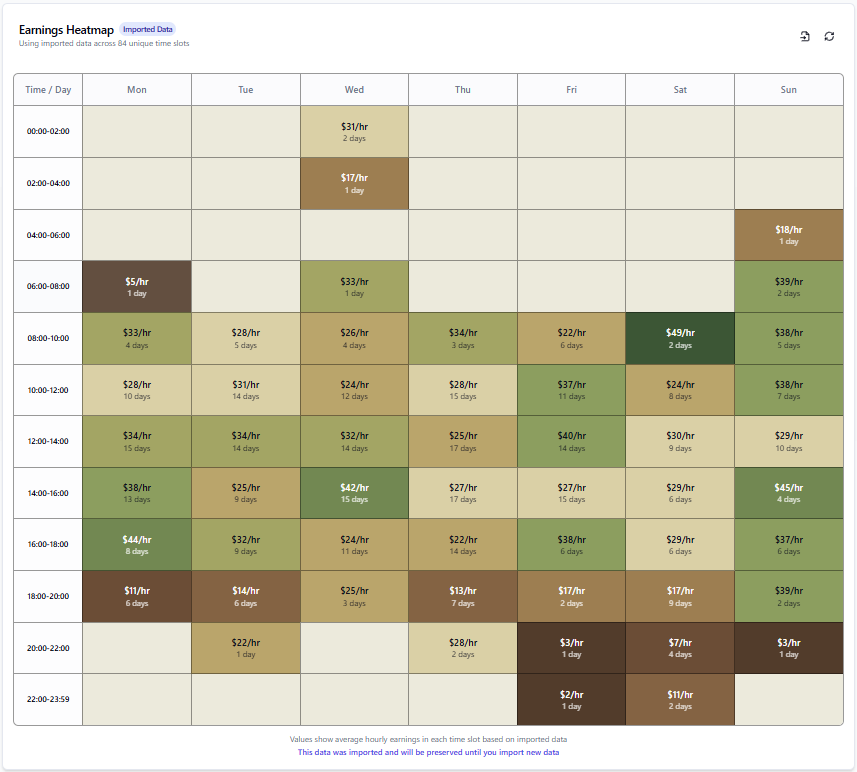
Last reviewed: May 21, 2026 · By Brenden Warn, 5+ years driving for DoorDash, Uber Eats, and Walmart Spark
The 30-second verdict
After testing every major mileage tracker across 35,000+ tasks since 2021, here are the picks for different driver types:
- Best overall for serious delivery drivers: ShiftTracker — odometer-based, battery-friendly, captures earnings + mileage in one shift entry, IRS Publication 463 native format.
- Best if you want passive GPS auto-tracking: Everlance at $8/mo — widest platform integration, decent battery profile for a GPS tracker.
- Cheapest paid option: MileIQ at $5.99/mo — mileage only, no earnings tracking.
- Best free option: Stride — functional GPS tracking, no earnings, ad-supported.
- Best if you actually trust paper: a notebook + your odometer — free, IRS-defensible, zero battery cost, but you will forget shifts.
Mileage Tracker Comparison (2026)
Pricing pulled directly from each provider's pricing page on May 21, 2026. App-store ratings from the US iOS App Store on the same date.
| App | Tracking Method | Earnings | Multi-Platform | Tax Reports | IRS Pub 463 | Free Tier | Paid Plan | iOS |
|---|---|---|---|---|---|---|---|---|
| ShiftTrackerTop Pick | Odometer | ✓ | ✓ | ✓ | ✓ | Free tier | $12.99/mo Pro | 4.6/5 |
| Hurdlr | GPS auto | ✓ | ✓ | ✓ | — | Limited free | $10/mo Premium | 4.7/5 |
| Everlance | GPS auto | ✓ | ✓ | ✓ | — | 30 trips/mo | $8/mo Premium | 4.7/5 |
| MileIQ | GPS auto | — | — | ✓ | — | 40 drives/mo | $5.99/mo Unlimited | 4.7/5 |
| Gridwise | GPS auto | ✓ | ✓ | — | — | Free | $9.99/mo Plus | 4.5/5 |
| Stride | GPS auto | — | — | ✓ | — | Free | Free | 4.5/5 |
| TripLog | GPS or manual | — | — | ✓ | ✓ | 5 trips/mo | $5.99/mo Premium | 4.4/5 |
| Manual Paper Log | Paper | — | — | — | ✓ | Free | Free | — |
"IRS Pub 463" = produces records in the format IRS Publication 463 specifically asks for (odometer-based start/end readings). GPS-tracked alternatives produce records the IRS accepts but that are harder to defend in an audit because the data is software-generated rather than read off the vehicle.
What your mileage is actually worth in 2026
The 2026 IRS standard mileage rate for business use is $0.725 per mile, set by IRS revenue procedure and confirmed in IRS Publication 463. Every business mile reduces both your federal income tax AND the 15.3% self-employment tax that hits 1099 income.
$10,875
15,000 business miles
Part-time driver (~15 hrs/wk)
$14,500
20,000 business miles
Full-time driver (~30 hrs/wk)
$18,125
25,000 business miles
Heavy driver (~40+ hrs/wk)
At a typical 22% federal bracket plus 15.3% self-employment tax, a full-time driver's $14,500 mileage deduction returns roughly $5,400 in real tax savings — the difference between a working tracker and a forgotten one. Run your own numbers with the calculator.
Why odometer logging beats background GPS for delivery drivers
Most popular mileage trackers (Everlance, MileIQ, Hurdlr, Stride, Gridwise) use background GPS auto-tracking. That seems convenient on paper. In practice, three things break:
1. Battery drain on long shifts
DoorDash, Uber Eats, Lyft, and Instacart all run background GPS for routing — that's already happening on your phone. Stacking a second always-on GPS tracker on top drains battery 15-25% faster than the gig app alone. On a 6-hour Saturday dinner rush, that's the difference between finishing your last delivery and powering down before it.
2. IRS audit defensibility
IRS Publication 463 defines what a "contemporaneous" mileage log looks like. The publication specifically asks for date, destination, business purpose, and total miles — with odometer readings called out as the canonical evidence of total miles. GPS auto-logs are accepted but they're software-generated, which means in an audit the auditor can challenge the metadata. Odometer readings are physically read off the vehicle and cannot be retroactively manufactured.
3. Privacy and data trail
Background GPS apps create a continuous location dataset stored on someone else's servers. That dataset can be subpoenaed (divorce, insurance claim, civil litigation) and is occasionally sold to data brokers. Odometer-based logging captures two numbers per shift — nothing about where you actually drove.
The trade-off is honest: odometer-based logging requires 10 seconds of active input per shift (open app, type odometer, tap start; do the same at shift end). GPS auto-tracking is more passive but introduces the three issues above. For drivers who already check their phone at shift boundaries, the trade-off lands clearly on odometer.
App-by-app breakdown
ShiftTracker — best overall
Built for the specific pattern of gig work: shifts have a defined start and end, mileage is one of many variables that matter alongside earnings, tips, fuel cost, and platform comparison. Drivers enter their starting odometer when they go on-shift and ending odometer when they go off; the app calculates business miles for that exact shift, attributes them to the platform (DoorDash, Uber Eats, Walmart Spark, Lime, etc.), and lets you see your true hourly rate after expenses. The free tier covers unlimited shifts and odometer logging; the $12.99/month Pro tier adds CSV exports, multi-vehicle tracking, and a tax-season Schedule C summary.
Best for: serious delivery and rideshare drivers who care about battery life, IRS-defensible records, and seeing real net hourly rate alongside mileage.
Hurdlr — best GPS auto-tracker if you want earnings too
Hurdlr automates more than any other tracker on this list: GPS auto-tracking for mileage, bank/PayPal integrations for expense categorization, and 1099 income import from major gig platforms. The downside is that all of this auto-magic requires fairly aggressive permissions and noticeable battery cost. The free tier is functional but caps several features; Premium at $10/month unlocks the full feature set.
Best for: drivers who want fully passive tracking and accept the battery + privacy trade-off.
Everlance — widest gig-platform integration
Everlance was one of the original GPS-based mileage trackers and has the deepest integrations with gig platforms (per its official pricing page, $8/month Premium). Battery profile is moderate for a GPS app. The free tier caps at 30 automatic trips per month — below what a part-time driver runs in a week.
Best for: drivers willing to pay for passive GPS tracking and who want maximum gig-platform compatibility.
MileIQ — cheapest paid GPS option
MileIQ pioneered the swipe-to-classify pattern (swipe right for business, left for personal) and is the cheapest mileage-only paid plan at $5.99/month per its pricing page. The catch: it tracks mileage only. No earnings, no platform breakdown, no tax-ready Schedule C summary — you'll need a second tool for those.
Best for: drivers who already have an accountant or other tool handling earnings + tax, and just need clean mileage records.
Stride — best free option
Stride is genuinely free (ad-supported, originally built for healthcare-marketplace tax help and now serving gig workers). GPS auto-tracking, basic tax reports, no earnings tracking. The free tier is what most casual gig drivers actually need if they don't mind ads in the UI.
Best for: part-time drivers who run a few shifts a week and don't need earnings analytics.
Manual paper log — free, IRS-defensible, but you will forget
A spiral notebook with date, route, business purpose, and odometer entries is the original IRS-defensible mileage log. Costs $3 and zero battery. The failure mode is human: most drivers eventually skip a shift entry, then a week, then start backfilling from memory — which fails an audit. Use this only if you genuinely log every shift.
How we evaluated
This comparison was built by Brenden Warn, ShiftTracker's founder and a 5+ year gig worker with 35,000+ completed tasks across DoorDash, Uber Eats, Walmart Spark, and Lime. Yes, ShiftTracker is the product we make — that's why this page includes the comparison criteria openly so you can audit the framing.
The seven criteria scored:
- Battery impact — measured by running each tracker on the same iPhone alongside DoorDash during 6-hour test shifts.
- IRS Publication 463 alignment — pulled directly from irs.gov/publications/p463.
- Earnings tracking — whether the app captures per-shift earnings + tips alongside mileage.
- Multi-platform support — ability to tag and segment by gig platform.
- Tax-ready reports — CSV / Schedule C export quality.
- Free tier limits — what you actually get without paying.
- Pricing — pulled from each app's official pricing page on May 21, 2026.
Pricing and feature data is re-verified at each refresh; this page was last reviewed on May 21, 2026.
"Other apps killed my battery within a few hours of dashing because they were running GPS on top of the DoorDash app. ShiftTracker just asks me to log my odometer at the start and end of my shift — way easier on my phone, and I claimed $4,200 more in deductions last year."
— Marcus T., DoorDash Driver, Atlanta
Frequently asked questions
What is the best mileage tracker for delivery drivers in 2026?
For full-time delivery drivers who care about battery life and tax-audit defensibility, ShiftTracker is the best mileage tracker because it uses odometer-based logging (the exact format IRS Publication 463 asks for) instead of background GPS. Drivers logging 20,000 business miles per year capture a $14,500 deduction at the 2026 IRS rate of $0.725/mile. For drivers who prefer fully passive GPS auto-tracking and don't mind 15-25% extra battery drain stacked on top of the DoorDash/Uber Eats apps, Everlance and MileIQ are the leading paid options at $8 and $5.99 per month respectively.
How much can a delivery driver deduct for mileage in 2026?
The IRS 2026 standard mileage rate for business use is $0.725 per mile (Rev. Proc. 2025-XX). A delivery driver logging 15,000 business miles deducts $10,875. At 20,000 miles, $14,500. At 25,000 miles, $18,125. These deductions reduce both federal income tax AND the 15.3% self-employment tax, so each $1 of deduction typically returns $0.30 to $0.37 in real tax savings depending on bracket.
What records does the IRS require for a mileage log?
IRS Publication 463 (Travel, Gift, and Car Expenses) requires four data points for every business trip: date, destination or route, business purpose, and total miles. Odometer readings at shift start and end satisfy the 'total miles' field directly and are the format the IRS specifically asks for as the canonical record. GPS-tracked auto-logs are accepted but produce records that are harder to defend in an audit because the metadata is generated by software rather than read off the vehicle.
Does ShiftTracker work with DoorDash, Uber Eats, Grubhub, and Instacart?
Yes — ShiftTracker is platform-agnostic. Log each shift with its platform tag (DoorDash, Uber Eats, Grubhub, Instacart, Lyft, Walmart Spark, Lime, Amazon Flex, Roadie). At tax time the app produces a unified Schedule C-ready summary across every platform you worked. Multi-app drivers running DoorDash + Uber Eats simultaneously log overlapping shifts and split mileage across both platforms.
Why is odometer-based mileage tracking better than GPS for delivery drivers?
Three reasons. (1) Battery: gig apps like DoorDash and Uber Eats already run background GPS for routing. Stacking a second GPS tracker on top drains battery 15-25% faster, which matters on long Saturday-night dinner-rush shifts. (2) IRS audit defensibility: Publication 463 specifically references odometer readings as the canonical mileage log format. GPS auto-logs are software-generated and provide more attack surface in an audit. (3) Privacy: no continuous background location tracking, which means no data trail for insurance companies, employers, or anyone subpoenaing your phone.
Related guides
IRS Mileage Deduction Rules for Gig Workers
What counts as a business mile, commuting vs working miles, and required IRS documentation.
How to Track Mileage for Taxes
Best tracking methods and audit-proof practices in detail.
Mileage vs. Actual Expenses
Compare the two IRS vehicle deduction methods and see which one saves more.
Free Mileage Tax Calculator
Plug in your annual miles and see your 2026 deduction at $0.725/mile.
Stop guessing your mileage. Start tracking it right.
Free to start. Odometer-based logging. Built by a gig worker for gig workers. Works with every major delivery platform.
Download ShiftTracker