Hourly Rate Calculator: Salary to Hourly + Gig Worker True Rate
By Brenden Warn, Founder & Gig Economy Analyst
Last reviewed against IRS.gov sources:
Two calculators in one. Convert any annual salary to an hourly rate ($60K = $28.85/hr, $70K = $33.65/hr at 2,080 working hours/year), or — if you're a gig worker — see your true hourly rate after gas, vehicle wear, and self-employment tax.
Salary to Hourly Converter
For W-2 employees, freelancers, or anyone comparing a salary offer to an hourly job.
Gross Hourly Rate
$0.00/hr
Estimated Take-Home Hourly (after ~25% W-2 tax)
$0.00/hr
Based on standard 2,080 hours/year
Gig Worker True Hourly Rate
For 1099 delivery, rideshare, and gig drivers. Captures gas, miles, and other shift-level expenses to show your real take-home per hour.
Gross Hourly Rate
$0.00/hr
True Hourly Rate (after expenses)
$0.00/hr
Gas Cost Estimate
$0.00
Net Earnings
$0.00
Common Salary to Hourly Conversions
Quick reference for the most common salary-to-hourly conversion questions. All figures use the standard 2,080 working hours per year (40 hours/week × 52 weeks). Take-home estimates assume single-filer, no state income tax, and standard 2026 federal brackets.
| Annual Salary | Hourly (gross) | Per Week (40 hrs) | Per Day (8 hrs) | Take-Home Hourly (~75%) |
|---|---|---|---|---|
| $30,000 | $14.42/hr | $576.80 | $115.36 | $10.81/hr |
| $40,000 | $19.23/hr | $769.20 | $153.84 | $14.42/hr |
| $43,000 | $20.67/hr | $826.80 | $165.36 | $15.50/hr |
| $50,000 | $24.04/hr | $961.60 | $192.32 | $18.03/hr |
| $55,000 | $26.44/hr | $1057.60 | $211.52 | $19.83/hr |
| $60,000 | $28.85/hr | $1154.00 | $230.80 | $21.64/hr |
| $65,000 | $31.25/hr | $1250.00 | $250.00 | $23.44/hr |
| $70,000 | $33.65/hr | $1346.00 | $269.20 | $25.24/hr |
| $75,000 | $36.06/hr | $1442.40 | $288.48 | $27.05/hr |
| $80,000 | $38.46/hr | $1538.40 | $307.68 | $28.84/hr |
| $90,000 | $43.27/hr | $1730.80 | $346.16 | $32.45/hr |
| $100,000 | $48.08/hr | $1923.20 | $384.64 | $36.06/hr |
| $120,000 | $57.69/hr | $2307.60 | $461.52 | $43.27/hr |
| $150,000 | $72.12/hr | $2884.80 | $576.96 | $54.09/hr |
Take-home is an estimate. Actual after-tax pay varies by filing status, state income tax, 401(k) contributions, health insurance, and other deductions. For precise after-tax figures, use IRS tax tables or a withholding calculator.
How to Convert Annual Salary to Hourly Rate
The math is simple: annual salary ÷ 2,080 = hourly rate. The 2,080 figure comes from a standard work year — 40 hours per week × 52 weeks.
For example: $60,000 ÷ 2,080 = $28.85 per hour. That's your gross hourly rate before any taxes are withheld. After federal income tax, FICA (7.65%), and state tax in most states, take-home is typically 70–80% of gross — so a $60K salary = roughly $21–$23/hour in your bank account.
Adjust the math if you take unpaid time off. Two weeks of unpaid leave reduces working hours from 2,080 to 2,000, which raises your effective hourly rate slightly: $60,000 ÷ 2,000 = $30.00/hour.
For part-time roles or non-standard schedules, just substitute your real working hours. $60,000 at 30 hrs/week × 52 weeks = $60,000 ÷ 1,560 = $38.46/hour.
Why Gig Worker Hourly Rate ≠ Salary-to-Hourly Conversion
A salary-to-hourly conversion assumes 100% of working time is paid time. That's not how gig work operates.
When DoorDash shows you "$25/hour," that's gross delivery pay during active orders. It doesn't subtract:
- − Gas and vehicle wear (about $0.15–0.20/mile)
- − Vehicle depreciation
- − Self-employment tax (15.3% — double the W-2 employee FICA rate of 7.65%)
- − Federal and state income tax
- − Time spent waiting between orders, dead miles, app issues
Net result: a $25/hr gross gig rate often becomes a $15–$18/hr true rate after expenses. The IRS standard mileage deduction at $0.76/mile from July 1, 2026 ($0.725 for January–June) recovers some of that at tax time, but only if you've kept proper records.
That's why Calculator B above exists — to capture the real numbers gig apps don't show you. See gross vs net income for gig workers for the full breakdown.
Frequently Asked Questions
$60,000 a year is how much an hour?
$70,000 (70k) a year is how much an hour?
$80,000 a year is how much an hour?
$50,000 a year is how much an hour?
$100,000 a year is how much an hour?
How do I convert my salary to an hourly rate?
Why is my gig worker hourly rate lower than a salary-to-hourly conversion?
Is hourly rate before or after taxes?
Track Every Shift Automatically
ShiftTracker calculates your true hourly rate for every shift — odometer-based mileage, full expense tracking, IRS-ready reports.


Related from the Blog
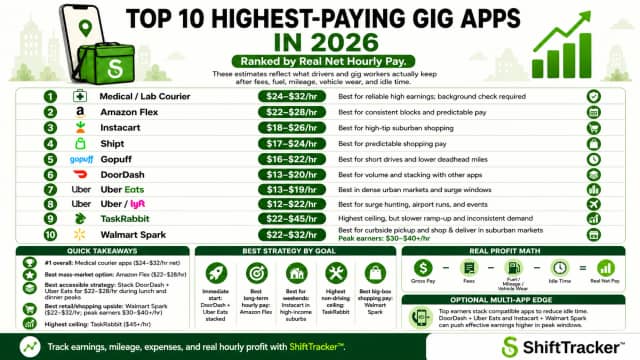
10 Highest-Paying Gig Apps in 2026 (Best for Same-Day Pay & Always-Hiring Platforms)
Medical courier apps, Amazon Flex, and Instacart lead the 2026 rankings for highest net hourly pay. DoorDash and Uber Eats rank 6th and 7th for solo drivers - but jump to $22+/hr when stacked together. See the full ranked list.

How Much Do Food Delivery Drivers Make in 2026? ($37K-$52K Gross, $26K-$39K Net)
Full-time food delivery driver earnings in 2026: real weekly pay for 20, 40, and 60 hours. Includes expenses, taxes, and tips to maximize take-home pay.

Figuring Out Your Yearly Earnings: Gross vs. Net Income Explained
Want to know your real yearly income? This guide breaks down gross vs. net earnings, explains payroll deductions, and shows how to calculate your annual income manually or with handy calculators. Perfect for gig workers, freelancers, and employees who want clarity for budgeting, taxes, or loan applications.
