Unlock Your Gig Economy Earnings with Smart AI Solutions
TL;DR
Gig workers who use data-driven shift planning earn 15–25% more per hour than those who rely on gut instinct alone.
Automated receipt scanning and GPS mileage logging cut weekly admin time by more than 10 hours for full-time gig workers.
The IRS standard mileage rate for 2026 is $0.725/mile — full-time drivers who track consistently save $3,500–$7,000 in taxes annually.
43% of independent contractors miss mileage deductions entirely due to incomplete or inconsistent recordkeeping.
AI-powered predictive models factor in day of week, local events, and historical demand to forecast shift income before you leave home.
Table of Contents
Free Download: 2026 Gig Worker Tax Survival Kit
Complete deduction checklist, IRS mileage guide, and quarterly tax calendar for 11 platforms.
AI Analytics for Gig Workers: How to Earn More in 2026
Gig workers who track their data earn 15–25% more per hour than those who don't. That gap isn't about working longer — it's about working smarter. AI-powered analytics tools turn your raw shift logs, mileage records, and expense receipts into concrete action: which zones pay best, which hours spike, and where money is quietly leaking out of every shift.
This guide breaks down exactly what gig economy data to collect, how AI converts it into winning strategies, and what to watch for on privacy. Specific tactics cover Lime Juicers, delivery drivers, and rideshare pros.
What Gig Economy Data Is — and Why It Changes Your Income
Gig economy data is every number generated by your work: fares, tips, fuel costs, miles, wait times, downtime between orders. Most workers collect it passively but never actually look at it. That's where most of the money gets lost.
The Five Data Points That Move the Needle
- Earnings per shift — broken down by platform and time window, not just a weekly lump sum
- Business miles driven — at the 2026 IRS rate of $0.725/mile, every mile logged is a real tax dollar saved
- Expenses by category — fuel, parking, phone, gear; these shrink your taxable income
- Hours worked — start/stop times reveal your true hourly rate, not the inflated one the app shows
- Bonuses and surge pay — tracking when these hit reveals repeatable patterns you can plan around
Independent contractors in the gig economy face unique recordkeeping challenges. IRS Publication 463 requires business expense records — including mileage logs — to include the date, destination, business purpose, and miles driven for each trip. Inadequate records are the leading cause of disallowed deductions during audits of self-employed taxpayers.
Source: IRS Publication 463, Business Travel Expenses (2025 edition)
Why Manual Tracking Fails at Scale
Spreadsheets and paper logs work — until they don't. The bigger problems with manual tracking:
- Time sink — logging every receipt and odometer reading eats hours each week
- Human error — transposed numbers produce wrong estimates and bad decisions
- Missed deductions — 43% of gig workers miss mileage deductions due to inconsistent records
- Stale data — yesterday's spreadsheet can't tell you where to position right now
Automation solves all four. It's not a luxury — it's the difference between knowing your real hourly rate and guessing.
How AI Converts Raw Shift Data Into Actionable Income Gains
AI doesn't need a big dataset to start being useful. Even two or three weeks of shift history gives machine learning models enough signal to spot patterns — peak windows, high-earning zones, expense trends — that are invisible to the naked eye.
The Core Technologies Behind Gig Analytics
- Machine learning algorithms — cluster your earnings by when, where, and which platform you worked
- Predictive modeling — forecast demand surges and estimate income for upcoming shifts
- Natural language processing — auto-sort expense receipts without you typing a word
- Anomaly detection — flag unusual spending or mileage spikes before they become problems
Predictive Income Models: How They Work
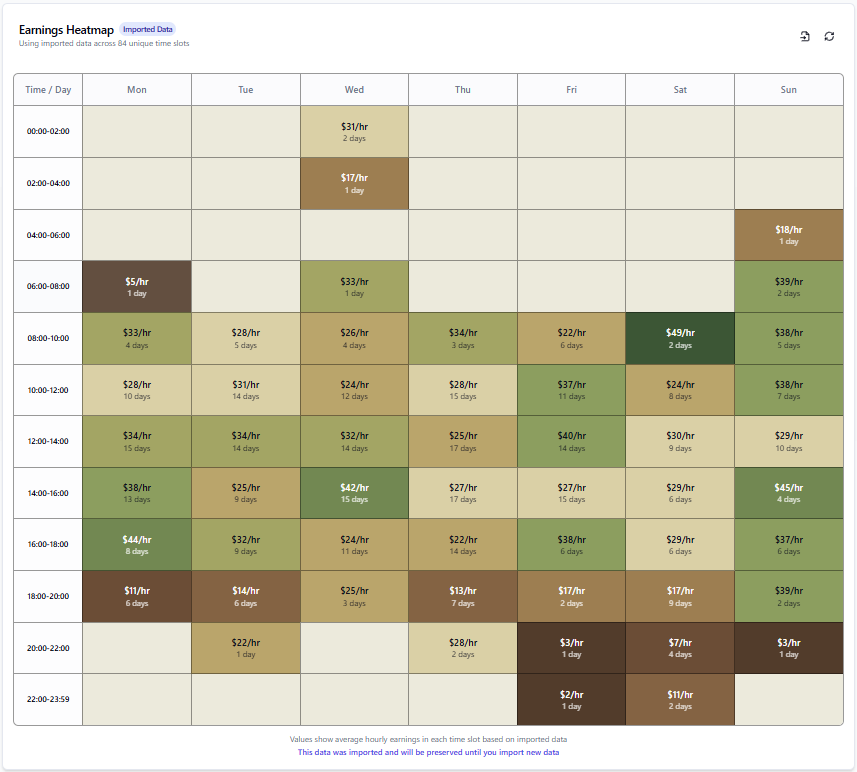
A predictive model looks at your past earnings alongside external signals — day of week, weather, local events, historical demand data — then estimates how much a given shift window is likely to pay. The best models update weekly as your data grows. Over time, the suggestions get sharper.
Drivers who follow AI scheduling recommendations consistently report 10–20% higher hourly averages compared to unguided scheduling.
Real-Time Feedback Loops
Live dashboards show your current earning pace, miles until you hit a tax deduction threshold, and spending trends mid-shift. Instant alerts suggest route changes or signal when demand is spiking nearby. This feedback makes each hour more productive — not by working faster, but by making better decisions in the moment.
Research from the JPMorgan Chase Institute found that gig platform workers experience 25% month-to-month income volatility, significantly higher than traditional employees. Workers who actively monitor their earnings data and adjust scheduling accordingly demonstrate measurably more stable monthly income outcomes.
Source: JPMorgan Chase Institute, Paychecks, Paydays, and the Online Platform Economy (2023)
Platform-by-Platform: AI Strategies That Work for Your Gig Type
The same data principles apply across gig types, but the specific variables differ. Here's how AI optimizes each role.
Lime Juicers: Charging Zones and Scooters-Per-Hour
For Lime Juicers, AI analyzes scooter availability, popular charging spot density, and historical usage patterns. The outputs:
- Best charging zones where scooter density meets payout per unit
- Ideal time windows aligned with peak rider activity
- Scooters-per-hour metrics to prioritize high-throughput routes
Check out our data-backed Lime juicing guide for zone-specific tactics.
Delivery Drivers: Zones, Rush Windows, and Route Efficiency
Delivery drivers benefit from AI that combines traffic data, restaurant wait times, and order volume. The practical outputs:
- Prioritize high-paying zones during lunch (11 AM–1:30 PM) and dinner (5–9 PM) rushes
- Optimize multi-stop routes to cut waiting time
- Predict surge opportunities on food delivery platforms before they disappear
These strategies increase average earnings per hour while cutting fuel and downtime costs. See our peak earning hours breakdown for platform-specific windows.
Rideshare Drivers: Demand Prediction and Surge Timing
Rideshare AI factors in demand prediction for high-fare areas, real-time supply data to avoid oversaturated markets, and shift timing reminders to log on before peak fares hit. The result: more premium rides, fewer unprofitable hours.
Key Benefits of Data-Driven Gig Work (With Real Numbers)
The case for analytics isn't abstract. Here's what the data shows:
| Benefit | Typical Outcome |
|---|---|
| Admin time saved (annual) | 140+ hours |
| Tax savings from tracked mileage (20,000 mi/yr) | $3,600–$4,900 |
| Hourly rate increase from AI scheduling | 10–25% |
| Gig workers who miss mileage deductions | 43% |
For a deeper look at how automation compares to manual logs, read our automation vs. manual tracking comparison.
Data Privacy: What AI Apps Do With Your Information
A common concern: what happens to your earnings, location, and bank data? Legitimate platforms use encryption for data at rest and in transit, anonymize analytics so individual identities aren't exposed in aggregate models, and comply with GDPR and CCPA requirements. Always check whether an app sells data to third parties before linking bank accounts or enabling continuous GPS.
Emerging Trends Worth Watching
- Edge AI on mobile — analysis without an internet connection
- Dynamic pricing alerts across multiple platforms simultaneously
- Integrated tax filing powered by machine learning
- Voice-activated logging for hands-free data capture
A 2024 Pew Research Center study found that 16% of Americans have earned money through gig platforms. Among active gig workers, those who use dedicated tracking tools report significantly higher satisfaction with their ability to manage taxes and understand their true net income compared to those using no tools or generic spreadsheets.
Source: Pew Research Center, The State of Gig Work in 2024
Comparison: AI-Powered Tracking vs. Manual Logs
| Feature | AI-Powered Tracker | Manual Log |
|---|---|---|
| Expense categorization | Automatic, machine learning | Manual, error-prone |
| Mileage tracking | Continuous GPS | Manual odometer entries |
| Income forecasting | Predictive models | None |
| Real-time alerts | Smart shift suggestions | No live feedback |
| Annual time saved | 140+ hours | 0 hours |
Also worth reading: our guide to gig analytics tools that boost earnings and tax accuracy.
How to Start Using AI Tools for Your Gig Work
Getting started takes minutes, not hours. Pick a platform, install the app, grant GPS and bank permissions, and let the first week of data accumulate. Review your dashboard after five shifts — most workers spot at least one scheduling insight that pays for itself immediately.
Key setup steps for any AI tracking app:
- Enable automatic trip detection and review initial classifications
- Photograph and categorize receipts as you go — don't batch them
- Check weekly analytics to spot peak windows and high-earning zones
- Export your first tax-ready report to verify the data is IRS-compliant
For more on getting your tax strategy right from day one, see our complete 1099 tax guide for gig workers.
Frequently Asked Questions
What data should gig workers track every shift?
Track earnings per shift, business miles driven, fuel and parking expenses, hours worked (start/stop times), and any bonuses or surge pay. Most full-time gig workers log 20,000–30,000 miles per year — at $0.725/mile that alone is $14,500–$21,750 in potential deductions.
How does AI predict the best times to work?
Predictive models analyze your personal earnings history alongside external signals — day of week, weather, local events, and platform demand data — to estimate shift income before you leave home. Drivers using these suggestions report 10–20% higher hourly averages over drivers using no scheduling guidance.
Is my gig data safe in AI-powered tracking apps?
Reputable apps encrypt data both at rest and in transit, use anonymized analytics, and comply with GDPR and CCPA. Always review an app's privacy policy before linking bank accounts or enabling GPS. Look for SOC 2 compliance as a baseline security indicator when comparing tools.
How much time does automated tracking actually save?
Gig workers who switch from manual spreadsheets to automated tracking apps report saving more than 10 hours per week on admin tasks. Over a full year, that adds up to 140+ hours — time that can go back into earning or rest rather than recordkeeping.
Can I use these tools for multiple platforms at once?
Yes. Multi-app gig workers benefit the most from AI analytics because the tools aggregate data across platforms into a single dashboard. Drivers running DoorDash, Uber Eats, and a third app simultaneously can compare net hourly rates across platforms and shift their focus to whichever is performing best at any given time.
Founder of ShiftTracker. 5+ years active gig work experience with 35,000+ completed tasks across Uber, DoorDash, Instacart, and Lime. Background in financial trading and behavioral optimization.
You Might Also Like
12 Best Gig Worker Apps for 2026: Maximize Your Earnings
See the best gig worker apps for 2026 — automate mileage, track expenses, use earnings analytics, an...
How Gig Economy Apps Evolved (2021–2025): Platforms, Trends, and Tools
Gig economy apps have evolved from simple dispatch tools into full work-optimization platforms. This...
Gig Worker Financial Literacy: Budgeting, Taxes, and Take-Home Pay
Learn data-driven earning tactics, deductible tracking, budgeting for irregular income, and quarterl...
Track your shifts smarter
Join 1,000+ gig workers using ShiftTracker to optimize earnings and simplify taxes.
Download the App