How to Get Your Tax Return Transcript as a Gig Worker (2026 Guide)
By Brenden Warn, Founder & Gig Economy Analyst · Updated May 2026
A tax return transcript is an IRS-issued summary of your filed return — free, instant online, and the standard way to prove self-employment income to lenders, landlords, and aid programs. Gig workers can't rely on W-2s, so a transcript is the document mortgage underwriters, auto lenders, and apartment managers actually want to see. Here's exactly how to get one in under 10 minutes.
What Is a Tax Return Transcript?
A tax return transcript is a free IRS-produced summary of your filed Form 1040 showing most line items as originally submitted — total income, adjusted gross income (AGI), taxable income, taxes owed, payments, and refund or balance. It is NOT a copy of your actual filed return; it's a condensed line-by-line summary the IRS produces from its own records.
For gig workers, the transcript is critical because it's the document that third parties trust. Lenders, landlords, and aid programs accept transcripts as IRS-verified income proof. They generally won't accept your self-prepared Schedule C, photos of 1099 forms, or a printout of TurboTax, because those aren't authenticated by the IRS.
Transcript vs. copy of return — quick distinction
- · Transcript: Free, instant online, IRS-issued summary of line items. Accepted by 95%+ of lenders, FAFSA, and aid programs.
- · Copy of return: Costs $43 per year via Form 4506, takes up to 75 days. Includes the full Form 1040 + all schedules and attachments. Only needed for court proceedings, complex audits, or rare lender requests.
The 4 IRS Transcript Types — Which One Do You Need?
The IRS issues four distinct transcript types, each for a different purpose. For most gig-worker situations, you only need the Tax Return Transcript — but knowing the difference matters when reconstructing lost 1099s or recovering from identity theft.
Tax Return TranscriptMost common
Shows: Most line items from your filed Form 1040 (income, AGI, taxable income, taxes, payments, refund/balance)
Years available: Current year + 3 prior years
Best for: Mortgage applications, FAFSA, car loans, apartment rentals — the most commonly requested type
⚠ Does NOT show changes made by you on amended returns or by the IRS during processing — for that you need a Tax Account Transcript or Record of Account.
Tax Account Transcript
Shows: Account-level info: filing status, AGI, taxable income, payment types, IRS adjustments and corrections
Years available: Current year + 9 prior years
Best for: Disputes with the IRS, tracking the status of an amended return, identity theft recovery
⚠ Updated weekly; reflects any IRS adjustments after the initial filing.
Wage and Income Transcript
Shows: Every information return filed about you: W-2s, 1099-NEC, 1099-K, 1099-MISC, 1099-INT, 1099-DIV, 1098-T, etc.
Years available: Current year + 9 prior years
Best for: Reconstructing income when you lost 1099 forms; verifying which gig platforms reported your earnings
⚠ May not be complete until July of the following year (employers and gig platforms file at different times).
Record of Account
Shows: Combination of Tax Return Transcript + Tax Account Transcript in one document
Years available: Current year + 3 prior years
Best for: Anything that needs a complete picture: complex amendments, audits, court proceedings
⚠ Most comprehensive but requested less often because most situations only need one of the two underlying types.
How to Get Your Tax Return Transcript (3 Methods)
All three IRS request methods are 100% free. Pick the one that matches your timeline and identity-verification capability.
Get Transcript Online (fastest)
Instant downloadFreeBest for: Anyone with a verified ID.me identity (driver license + selfie or other documentation)
- 1. Go to irs.gov/transcript
- 2. Click "Get Transcript Online"
- 3. Sign in with ID.me (or create an account — verification takes 5–15 minutes the first time)
- 4. Choose the transcript type and year
- 5. Download as a PDF, view in browser, or print
⚠ Identity verification through ID.me is required by federal law. If you do not have a U.S. driver license or passport, you will need to use a different method.
Get Transcript by Mail
5–10 business daysFreeBest for: Anyone who cannot pass online identity verification, or who prefers a physical copy
- 1. Go to irs.gov/transcript and click "Get Transcript by Mail"
- 2. Enter SSN, date of birth, and the address from your most recent return
- 3. Choose the transcript type and year
- 4. Wait 5–10 business days for the IRS to mail it to your address of record
⚠ The IRS will only mail it to the address on your most recent tax return. If you have moved since filing, file Form 8822 first to update your address before requesting by mail.
Form 4506-T (mail or fax)
10–30 business days for mail; 5–10 days for faxFreeBest for: Authorizing a third party (lender, accountant) to receive your transcript directly
- 1. Download Form 4506-T from irs.gov/forms-pubs/about-form-4506-t
- 2. Fill in your name, SSN, current address, and the transcript type + year
- 3. List the third party on line 5a if you want it sent to them directly
- 4. Sign and mail to the address listed for your state, OR fax to the number provided
⚠ This is the form most lenders use during loan underwriting — they'll often have you sign one as part of the application packet.
When Gig Workers Actually Need a Tax Return Transcript
The five scenarios where a transcript is the difference between approval and rejection — or between paying prime rates and getting denied entirely. Self-employed income is invisible to most third parties without IRS verification.
Mortgage or refinance application
→ Use: Tax Return Transcript (last 2 years)
Lenders require IRS-verified income because gig workers do not have W-2s. They'll send Form 4506-C through their underwriter to pull transcripts directly. Self-prepared income statements are not enough — banks need IRS confirmation.
Car loan or auto refinance
→ Use: Tax Return Transcript (last 2 years)
Auto lenders increasingly verify self-employment income against IRS records before approving above-prime rates. Especially common for newer credit profiles or higher loan amounts.
Apartment rental application
→ Use: Tax Return Transcript (last 1–2 years)
Property managers in competitive markets ask for IRS-verified income from 1099 applicants. Many use Form 4506-C as part of the application, others ask you to provide your transcript directly.
FAFSA or student loan application
→ Use: Tax Return Transcript (most recent year)
The FAFSA IRS Data Retrieval Tool pulls transcript data automatically, but students whose parents are self-employed sometimes need to provide a paper transcript if the auto-pull fails.
Reconstructing lost 1099 forms
→ Use: Wage and Income Transcript
If you lost or never received a 1099-NEC or 1099-K from DoorDash, Uber, Walmart Spark, or any other platform, the Wage and Income Transcript shows every information return filed under your SSN — even ones you didn't get. This is the only way to reliably reconstruct gig income for past years.
Common Problems & How to Fix Them
"Transcript not available yet"
Your return hasn't fully processed yet. E-filed returns become available 2–6 weeks after acceptance; paper-filed returns 6–8 weeks. If it's been longer than 8 weeks, check return status at irs.gov/refunds first.
ID.me verification failed
Common causes: blurry license photo, expired ID, name mismatch with SSN records. Try the by-mail option instead — it only requires SSN, date of birth, and address from your most recent return. Or upgrade to ID.me's video verification (a live agent verifies you on a video call, slower but more flexible).
Mailing address has changed since I filed
By-mail transcripts only ship to the address on your most recent return. File Form 8822 (Change of Address) first, wait 4–6 weeks for processing, then request the transcript. Or use the online method instead — it doesn't require a current mailing address.
Lender wants Form 4506-C (not transcript directly)
Modern mortgage lenders use Form 4506-C to pull transcripts directly from the IRS during underwriting. You sign it; the IRS sends them the transcript. This is preferred over you sending a PDF because the IRS-direct path eliminates fraud concerns. If your lender requires 4506-C, sign it as part of the loan application packet — don't try to send your own transcript instead.
For the full picture of how Schedule C income flows from your gig platforms to your tax return — and ultimately to your transcript — see our pillar on how tax write-offs work for 1099 gig workers and the complete 1099 tax filing guide.
Frequently Asked Questions
What is a tax return transcript?
How do I get a tax return transcript?
How long does it take to get a tax return transcript?
What is the difference between a tax return transcript and a tax return copy?
Why do gig workers need a tax return transcript?
Can I get a tax return transcript for previous years?
What if I lost my 1099 forms from gig platforms?
Is the tax return transcript free?
Ready for Tax Season?
ShiftTracker logs your odometer and earnings across every gig platform — so when the IRS issues your transcript next year, the income lines and Schedule C deductions match exactly. No reconstruction, no surprises, no audit risk.
Download the AppRelated from the Blog

1099 Taxes for Gig Workers 2025: Deductions, Mileage & Quarterly Guide
New to 1099 work? This definitive guide covers contractor status, 1099-NEC, self-employment tax, quarterly estimates, and every deduction that matters—plus how ShiftTracker™ automates mileage, expenses, and tax-ready reports so you keep more of what you earn.
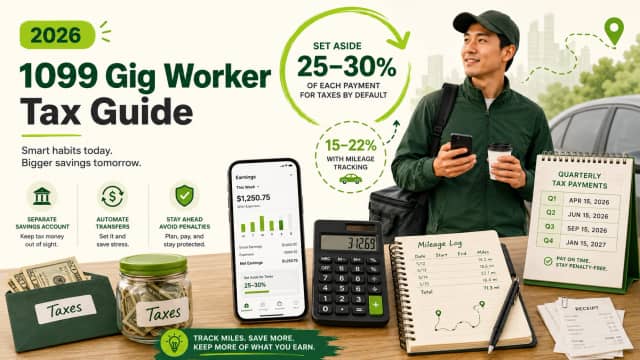
How Much Should I Set Aside for Taxes as a 1099 Gig Worker? (2026 Guide)
A 1099 gig worker should set aside 25-30% of every payment for taxes by default — but with tracked mileage at the 2026 IRS rate of $0.76/mile (July 1, 2026 onward), the real number drops to 15-22%. Full breakdown with quarterly schedule, worked examples for single/MFJ/HoH filing statuses, and the 5 mistakes most drivers make.

Gig Tax Deductions 2025: Maximize Mileage & Expenses
Learn which gig expenses are deductible in 2025, how the mileage rate works, and how Shift Tracker automation prevents missed write-offs and audits.