Instacart Earnings Calculator (2026)
By Brenden Warn, Founder & Gig Economy Analyst
See what you really earn per hour after gas, mileage, and taxes. Built for full-service shoppers maximizing tips and minimizing expenses.
Instacart Batch Calculator
Effective hourly rate: $0.00/hr
ShiftTracker calculates this automatically for every delivery.
How to Calculate True Instacart Earnings
Log Every Batch
Track base pay, heavy item bonuses, and customer tips for every batch you shop.
Track Mileage Start to End
Log every mile from opening the Shopper app to closing it - including driving between stores.
Apply the 2026 IRS Mileage Deduction
Deduct $0.725 per mile for miles driven January-June and $0.76 per mile from July 1 on your Schedule C. This is your biggest tax shield as an Instacart shopper.
Reserve for Quarterly Taxes
Set aside part of every payout for self-employment tax (15.3% of net earnings) plus federal income tax.
What ShiftTracker Tracks for Instacart Shoppers
All Earnings Sources
- Batch base pay
- Customer tips (before + after)
- Heavy order bonuses
- Peak Boost bonuses
Expense Tracking
- Automatic mileage logging
- Gas and maintenance
- Insulated bags and supplies
- Parking and tolls
Analytics
- True net hourly rate
- Best-paying stores
- Peak window heatmap
- Tip-per-batch trends
Instacart Batch Pay Explained
Batch Pay: Base $4-$10 per batch based on items, distance, and complexity. Multi-customer batches pay more but take longer.
Heavy Pay: Automatic $5-$10 bonus for orders with cases of water, pet food, or bulk items.
Tips: Shown upfront but modifiable for 24 hours after delivery. Average $7-$15 per batch; high-income suburbs see $15-$25.
Peak Boost: Per-batch bonus during high demand, most common on weekends and bad weather.
Shopping Speed: Faster shoppers get premium batch offers first. Learning store layouts directly increases your hourly rate.
Instacart Shopper FAQs
How much do Instacart shoppers really make per hour?
Gridwise's tracked data on 20,538 Instacart shoppers (2025) shows a median of $12.21/hour in trip pay and $12.51/hour including all earnings, with the top 10% at $18.44/hour or more. That is gross, before gas, vehicle costs, and taxes. Tips were about 42% of trip pay, so they are the biggest variable in your hourly rate.
How is Instacart batch pay calculated?
Instacart batch pay combines a base pay (which depends on order size, distance, and number of items) with customer tips added before or after delivery. Gridwise's tracked median is $12.79 per batch including tips (2025 data). Larger batches with multiple customers pay more per trip. Heavy or bulky items add a small bonus.
Do Instacart shoppers really need to track mileage?
Yes. Business miles are deductible at the 2026 IRS rates: $0.725/mile for January-June and $0.76/mile from July 1, so every 1,000 business miles driven from July 1 is a $760 deduction (Notice 2026-10; IRS Announcement 2026-11; IRS Publication 463 explains which miles count). Untracked mileage is deduction money left on the table.
Is Instacart better than DoorDash for earnings?
It depends on your market and the batches you take. Gridwise publishes tracked medians for both apps (Instacart: $12.51/hour gross including all earnings, 2025 data), so compare them, then check your own tracked shifts. Tips are a bigger share of Instacart pay (about 42% of trip pay per Gridwise). DoorDash may offer steadier order volume and less in-store time. Many drivers run both.
What expenses can Instacart shoppers deduct on taxes?
Instacart shoppers can deduct mileage ($0.725/mi Jan-Jun, $0.76/mi from Jul 1 in 2026), phone and data costs, insulated bags, gloves, parking fees, car washes, and a portion of auto insurance. Health insurance premiums may also be deductible. Track everything in ShiftTracker to maximize your refund.
Know Your True Instacart Earnings
Stop guessing. Track your real hourly rate, tips, and mileage with ShiftTracker.


Related from the Blog

Is Instacart Worth It in 2026? Real Shopper Earnings and the Honest Answer
Instacart pays $18-$26/hour net in 2026 for full-service shoppers in high-income suburbs, but drops to $13-$16/hour in saturated markets. Here is an honest breakdown of who should shop and who should skip it.

Walmart Spark vs. Instacart: Pay, Tips & Net Earnings Compared
Walmart Spark or Instacart — which gig app pays more in 2025? This in-depth breakdown compares base pay, bonuses, tips, time investment, and expenses to reveal true net earnings. Learn how scheduling, customer service, and tools like ShiftTracker™ can help you maximize income and stay audit-ready.
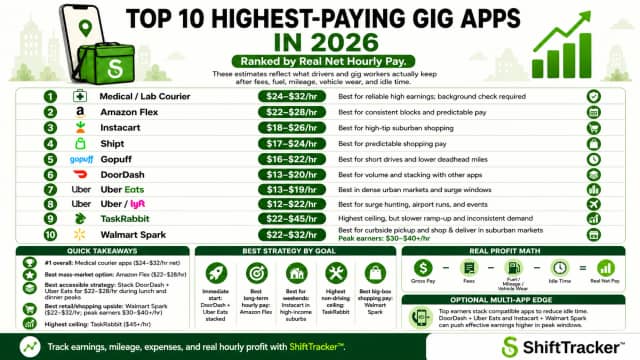
10 Highest-Paying Gig Apps in 2026 (Best for Same-Day Pay & Always-Hiring Platforms)
Medical courier apps, Amazon Flex, and Instacart lead the 2026 rankings for highest net hourly pay. DoorDash and Uber Eats rank 6th and 7th for solo drivers - but jump to $22+/hr when stacked together. See the full ranked list.
