How Much Do Lyft Drivers Make in 2026?
Most Lyft drivers gross $18–$25 per hour in 2026, but the number you actually keep is lower — typically $11–$18/hour net after gas, vehicle wear, and taxes. This hub breaks down real Lyft pay by hour, week, and year, by market, and most importantly: what's left after expenses.
Last reviewed: June 1, 2026 · By Brenden Warn, ShiftTracker founder, Lime LP for almost 4 years · 42,000+ tasks completed
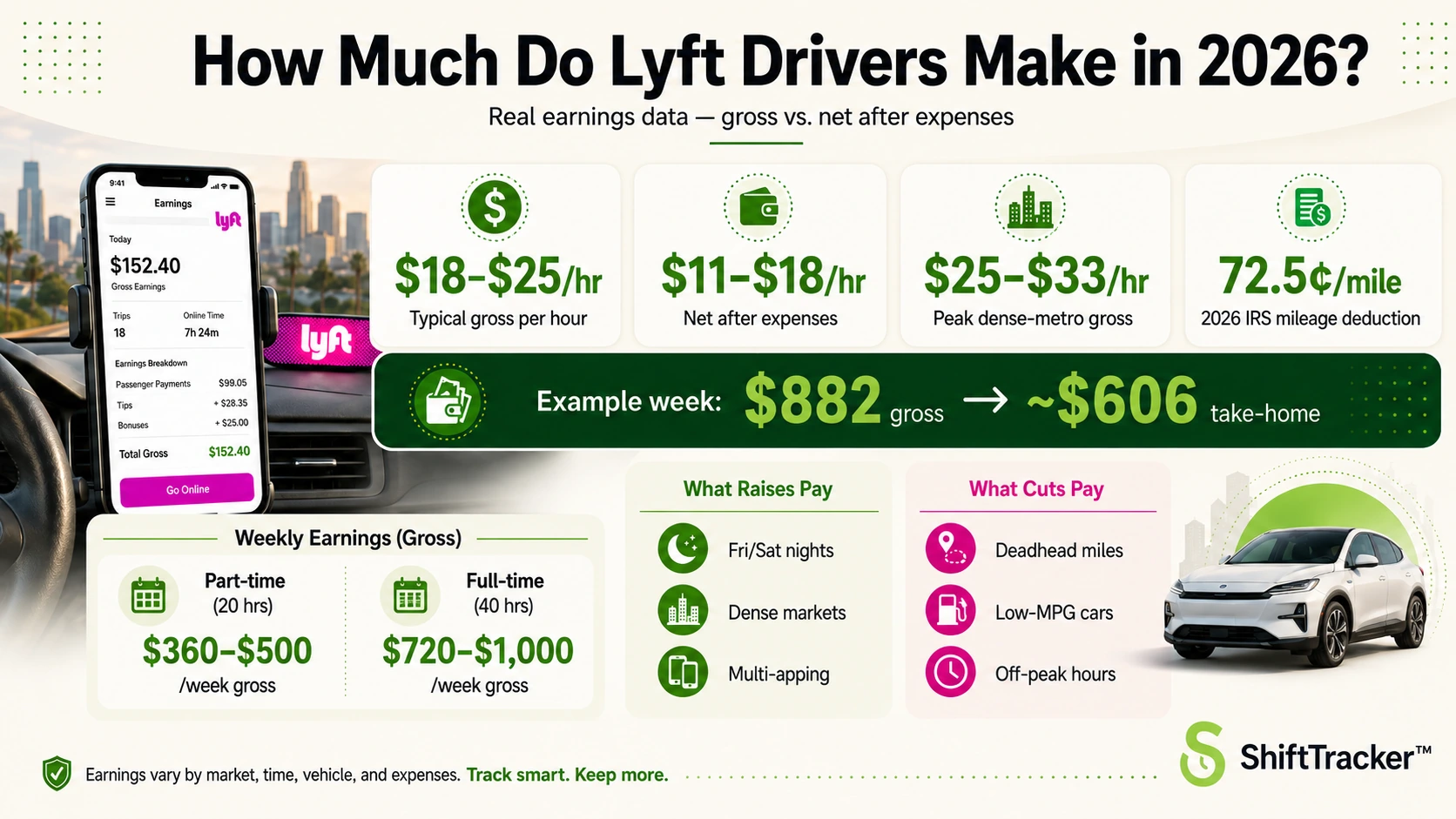
The Short Answer
- Per hour: $18–$25 gross in most markets; $25–$33 in dense metros at peak; $11–$18 net after expenses.
- Per week: ~$360–$500 part-time (20 hrs), ~$720–$1,000 full-time (40 hrs) gross.
- Per year: roughly $30,000–$48,000 gross full-time before expenses; net is materially lower.
- Net is 60–75% of gross. Gas, vehicle wear, and the 15.3% self-employment tax are the big subtractions; the 2026 IRS mileage deduction (72.5¢/mile January–June, 76¢/mile from July 1) offsets much of the tax.
- Where + when you drive matters more than how many hours. Dense markets and weekend peaks dwarf suburban off-peak pay.
How much do Lyft drivers make per hour?
National gross pay for Lyft drivers clusters around $18–$25 per hour in 2026, with wide variance by market and time of day. Driver-reported data aggregated by Gridwise and salary aggregation from Indeed both land in this range. The figure Lyft advertises in recruiting is a gross hourly number measured during active trips — it does not subtract your costs.
The single biggest driver of your hourly rate is market density. Dense urban markets pay more per active hour because trips are shorter and demand is constant:
| Market type | Gross $/hr (typical) | Gross $/hr (peak) | Example markets |
|---|---|---|---|
| Dense metro | $23–$27 | $27–$33 | NYC, SF, Boston, Seattle, DC |
| Mid-density metro | $18–$23 | $23–$28 | Atlanta, Denver, Austin, Chicago |
| Suburban / sprawl | $14–$18 | $18–$24 | Phoenix, DFW, Houston, Vegas |
Ranges reflect gross pay during active hours. Peak columns assume Friday/Saturday nights or surge events. Figures synthesized from Gridwise driver data, Indeed salary aggregation, and Lyft's own driver earnings guide.
Gross vs. net: what Lyft drivers actually keep
This is the number almost no one quotes. A Lyft driver grossing $1,000 in a week typically nets $600–$750 after all real costs. Here's the math for a mid-density driver running 42 hours at ~$21/hr gross, driving 520 total miles that week:
| Line item | Amount |
|---|---|
| Gross Lyft pay | $882.00 |
| Less: gas + maintenance (520 mi × ~$0.32) | −$166.40 |
| Less: rideshare insurance endorsement (amortized) | −$8.65 |
| Less: phone + data (amortized) | −$6.50 |
| Subtotal cash net before tax | $700.45 |
| Less: self-employment + income tax reserve (~17%) | −$94.00 |
| Net weekly take-home | ~$606 |
| Effective net hourly | ~$14.43/hr |
That's roughly a 31% haircut from gross to net. The good news at tax time: the 2026 IRS standard mileage rate of $0.76 per business mile from July 1 ($0.725 for January–June) (IRS Publication 463) is larger than your cash cost per mile, so it shelters a big chunk of income from tax. A driver logging 25,000 business miles a year, split evenly across the two rates, captures an $18,562.50 deduction ((12,500 × $0.725) + (12,500 × $0.76)) — but only if they keep a contemporaneous odometer log. Reconstructing miles from memory in April doesn't survive an audit.
Run your own numbers with our rideshare earnings calculator and 1099 tax calculator before you decide whether full-time Lyft driving pays enough in your market.
How much do Lyft drivers make a week and a year?
Weekly and annual pay scale with hours, but not linearly — because peak windows pay so much more than off-peak, a driver who concentrates 30 hours in peak windows can out-earn one who grinds 45 hours at random times. Typical gross figures:
| Schedule | Gross / week | Gross / year | Est. net / year |
|---|---|---|---|
| Part-time (15–20 hrs) | $300–$480 | $15,000–$24,000 | $10,000–$17,000 |
| Full-time (35–40 hrs) | $720–$1,000 | $32,000–$48,000 | $22,000–$34,000 |
| Heavy full-time (50+ hrs, dense market) | $1,100–$1,500 | $50,000–$68,000 | $34,000–$47,000 |
Annual figures assume ~48 working weeks. Net estimates apply the 60–75% gross-to-net ratio from the breakdown above. These are pre-deduction taxable estimates; your actual take-home depends heavily on vehicle efficiency and how disciplined you are about the mileage deduction.
What affects how much you make on Lyft?
Raises your pay
- ✓ Driving peak windows (Fri/Sat nights, commute hours, events)
- ✓ Dense urban markets with short trips + constant demand
- ✓ Surge / Personal Power Zones during high demand
- ✓ Airport queues during flight banks
- ✓ A fuel-efficient, paid-off vehicle (keeps more of every gross dollar)
- ✓ Multi-apping with Uber to fill idle time
Eats into your pay
- × Long deadhead miles between rides (sprawl markets)
- × Low-MPG or financed vehicles (depreciation + gas)
- × Driving off-peak hours for low hourly rates
- × Skipping the rideshare insurance endorsement (coverage-gap risk)
- × Not tracking mileage — you lose the biggest tax deduction
In my own rideshare years, the gap between my best-paying weeks and my worst wasn't hours worked — it was discipline about when I drove. Concentrating on Friday/Saturday nights and weekday commute peaks lifted my effective hourly by roughly a third versus filling random midday hours.
Do Lyft drivers make more than Uber drivers?
In most US markets the per-hour gross is within a dollar or two between the two platforms — the bigger variable is which app has more ride volume in your specific city at the time you drive. That's exactly why most full-time rideshare drivers run both apps at once and accept whichever offer pays better, which commonly lifts hourly earnings 15–30% over single-app driving.
If you're weighing the two, see our companion guides on whether Lyft is worth it in 2026 and the Uber and Lyft driver requirements + setup guide. Rideshare insurance is a commonly overlooked cost for both — our rideshare insurance guide covers the endorsement you likely need.
Frequently asked questions
How much do Lyft drivers make per hour in 2026?
Most Lyft drivers gross $18-$25 per hour in 2026 before expenses, with dense markets like New York, San Francisco, Boston, and Seattle reaching $25-$33/hour during peak windows and slower suburban markets running $14-$18/hour. After gas, vehicle wear, and self-employment tax, net take-home typically lands at $11-$18/hour. The gross number Lyft advertises is meaningfully higher than what you actually keep.
How much do Lyft drivers make a week?
A part-time Lyft driver working 20 hours per week typically grosses $360-$500; a full-time driver at 40 hours grosses $720-$1,000 in most US markets, higher in dense metros during surge-heavy weeks. Net weekly take-home after gas, vehicle wear, and tax reserves usually runs 60-75% of gross. Weekend nights (Friday and Saturday) account for a disproportionate share of weekly earnings.
Do Lyft drivers make more than Uber drivers?
Pay is close and market-dependent. In most US cities the per-hour gross is within a dollar or two between Lyft and Uber, and the bigger earnings driver is which platform has more ride volume in your specific market at the time you drive. Many full-time drivers run both apps simultaneously and accept whichever offer pays better, which lifts hourly earnings 15-30% versus single-app driving.
What expenses come out of Lyft driver pay?
The big ones are gas, vehicle maintenance and depreciation (together roughly $0.30-$0.35 per mile in cash cost), the rideshare insurance endorsement most personal policies require, phone and data, and self-employment tax of 15.3% plus federal income tax. The 2026 IRS standard mileage deduction (72.5 cents per business mile for January-June, 76 cents from July 1) offsets a large share of the tax burden at filing time, but week-to-week cash flow runs at the lower net number.
How can Lyft drivers make more money?
The highest-leverage moves are driving peak windows (Friday and Saturday nights, weekday commute hours, and event surges), positioning near high-demand zones like airports and nightlife districts, multi-apping with Uber to fill idle time, and tracking your true net per hour by market so you stop driving the hours and zones that actually lose money after expenses.
Related guides
Related from the Blog

Is Lyft Worth It in 2026? Real Driver Earnings and the Honest Answer
Lyft earnings swing widely by city, hours and deadhead miles, and Friday/Saturday nights are where surge tends to concentrate. Here is the honest breakdown of who should drive Lyft vs DoorDash, Uber, or skip rideshare entirely.

Uber & Lyft Driver Requirements 2025: Earn More & Get Started
Thinking about driving for Uber or Lyft in 2025? This guide explains everything — from age and vehicle requirements to background checks, pay calculations, and tax-saving strategies using Shift Tracker. Learn how to qualify fast and earn smarter behind the wheel.

Understanding Rideshare Insurance: Complete Guide for Uber & Lyft Drivers
Learn what rideshare insurance covers, why Uber and Lyft drivers need it, how much it costs, and how to avoid coverage gaps with the right policy and tracking tools.
Know your true Lyft hourly rate
Gross pay is the headline; net is what you keep. ShiftTracker tracks your earnings across Lyft and every other app, logs your odometer-based mileage in the IRS Publication 463 format, and shows your real hourly rate after gas and taxes — so you drive the hours that actually pay.
Try ShiftTracker Free for 7 Days