DoorDash in New York 2026: Minimum Wage Law, Tipping Settlement, and Real Dasher Pay
The Short Answer
- NYC requires delivery apps to pay a $19.56/hour minimum rate on active work — tips do not count toward the minimum.
- The DoorDash class-action tipping settlement (2017–2019) paid out $16.75M to affected NYC Dashers in 2024–2025.
- Typical NYC peak pay: $22–$28/hour net take-home after expenses in Manhattan or dense Brooklyn.
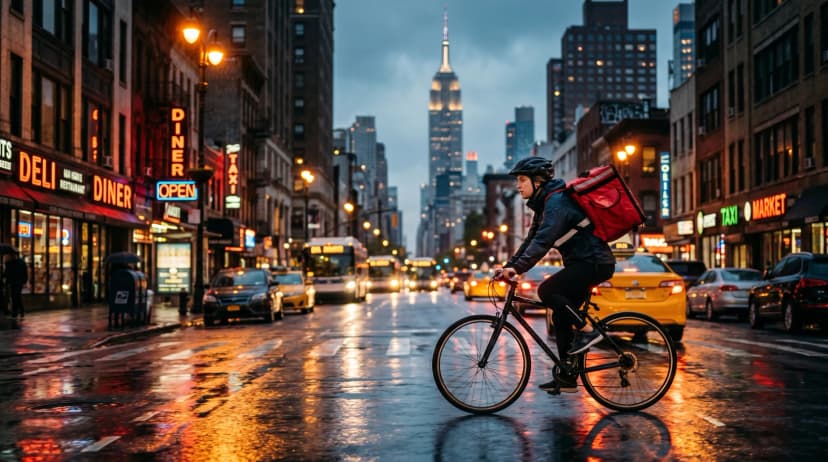
- Bike couriers have a structural advantage over cars in Manhattan; outer boroughs favor car Dashers.
- Best earning windows: weekday dinner 5:30–9:30pm and Friday/Saturday 10pm–1am in nightlife zones.

See your real hourly rate after car costs.


Table of Contents
Dashing in New York City in 2026 is fundamentally different from dashing anywhere else in the US. A mandatory $19.56/hour minimum pay rate for delivery workers, a finalized class-action tipping settlement with DoorDash, and the densest order flow in the country have reshaped how pay actually works here. Most NYC Dashers working regular peak windows now net between $22 and $28 per active hour after expenses, noticeably higher than the national average, but only if you know how the new rules interact with your tips, app selection, and zone strategy.
New York's $19.56/Hour Delivery Worker Minimum Pay Law
In late 2023, New York City became the first major US jurisdiction to require third-party delivery apps to pay couriers a minimum hourly rate. The rate has been adjusted upward since and sits at $19.56/hour of active work going into 2026. It applies to DoorDash, Uber Eats, Grubhub, and Relay operating within the five boroughs.
A few things most Dashers misunderstand about the law:
- It applies to active time only: the time between accepting an order and completing the delivery. Waiting time between dashes doesn’t count toward the minimum.
- Apps can pay the minimum two ways: either per trip (with a formula based on distance and duration) or as a true hourly floor. DoorDash typically uses the per-trip method, which means your take-home can still exceed the floor on high-tip orders.
- Tips do not count toward the minimum: the platform must hit $19.56 on base pay alone, and tips go on top. NYC Dashers often see higher base pay per order than drivers in other markets as a result.
- Multi-apping is still legal, but each platform must hit the minimum separately during the hours you’re online with them.
The law was challenged in court by DoorDash, Uber, and Grubhub but upheld in 2024. The practical result for drivers: consistent higher base pay floor, slightly harder order access during off-peak hours (because platforms throttle supply to stay profitable), and a more stable hourly floor when tip volume dips.
The DoorDash Tipping Settlement: What NYC Dashers Should Know
DoorDash settled a class-action lawsuit filed by the New York Attorney General in 2023 over its former “tipping model” that used customer tips to offset driver base pay. The settlement required DoorDash to pay out $16.75 million to affected Dashers who worked in New York between 2017 and 2019 under that old pay structure.
If you dashed in New York during that window, check your email for settlement notifications. Payouts went out in staggered waves through 2024 and 2025. If you started dashing after 2019, the settlement doesn’t apply to you, but the tip-transparency changes it forced through are the reason tips today go 100% to the driver, separate from base pay.
Real NYC DoorDash Earnings in 2026
After factoring in the minimum pay law, here’s what a typical weekly earnings spread looks like for NYC Dashers in 2026, based on driver reports and observed shift data:
- Weekday lunch (11am–2pm) in Manhattan: $75–$105 gross for a 3-hour block. High density, high tips, restaurant-dense zones carry you.
- Weekday dinner (5pm–9pm) in Manhattan or dense Brooklyn: $95–$140 gross for a 4-hour block. This is peak NYC DoorDash earning time.
- Friday/Saturday late night (10pm–1am): $80–$120 for 3 hours. Bars and clubs generate large group orders with higher tips.
- Weekend brunch outer boroughs (Queens, Bronx): $60–$85 for 3 hours. Lower density but less competition.
- Off-peak weekday (2pm–4pm): $35–$55 for 2 hours. Not worth dashing unless you’re already out.
Net take-home after subway/bike costs, phone use, and self-employment tax set-aside (roughly 25–30% of earnings) usually lands in the $22–$28 per active hour range during peak windows. That’s a meaningfully higher floor than most US markets thanks to the minimum pay law.
Best Zones to Dash in New York City
Manhattan
Midtown (roughly 34th to 59th) is the densest order-flow zone in the entire US. Lunch is dominated by corporate orders with modest tips; dinner shifts to bigger residential orders with stronger tipping. Bike Dashers have a big edge here, because cars are useless in Midtown traffic.
Lower Manhattan / FiDi is weekday lunch gold, dies after 6pm on weekdays.
Upper East Side and Upper West Side are strong weekend dinner zones with better-than-average tips.
Brooklyn
Williamsburg, Bushwick, and Park Slope have the strongest Brooklyn dinner and weekend late-night earning. Car Dashers do better here than in Manhattan.
Queens and the Bronx
Lower order density but also less platform competition. Reliable secondary markets when Manhattan is saturated. Stronger for car drivers because parking is actually possible.
Peak Hours in NYC Specifically
New York’s peak windows run longer and later than most US cities:
- Lunch: 11:30am–2:00pm weekdays
- Dinner: 5:30pm–9:30pm daily
- Late night: 10:00pm–1:00am Friday and Saturday, 10pm–midnight Sunday
- Weekend brunch: 10:00am–1:30pm Saturday and Sunday
Sunday evening into Monday morning is one of the slowest windows, so many Dashers use it to meal-prep, do taxes, or run errands instead.
NYC-Specific Dasher Expenses
New York changes the expense equation in ways other markets don’t:
- Bike wear & replacement: If you’re a bike Dasher (which is the majority in Manhattan), expect $30–$60/month in tire, chain, and brake pad wear. E-bikes can accelerate this considerably but let you cover more ground per hour.
- E-bike battery replacement: $200–$400 every 18–24 months for heavy users. NYC law now mandates UL-certified e-bike batteries after the 2023 apartment fire legislation.
- Parking tickets (car Dashers): Budget for at least one $115 NYC parking ticket per month if you dash in Manhattan with a car. Many car Dashers switch to the outer boroughs specifically to avoid this tax.
- Subway fares on the clock: If you’re positioning to a better zone, the $2.90 subway fare is deductible as a business expense.
- Weatherproof gear: Winter shell + insulated delivery bag + rain cover. Figure $150–$250 one-time startup cost.
Every one of these is deductible on Schedule C if you track them. The 2026 IRS standard mileage rate of 76¢ per mile from July 1, 2026 (72.5¢ for January–June) still applies if you drive in the outer boroughs (see our 2026 IRS mileage rate guide for the full deduction math).
Is DoorDash Worth It in NYC in 2026?
The minimum pay law has been a net positive for serious Dashers. The hourly floor is now meaningfully higher than most US markets, and the tipping rules ensure your tips are additive rather than absorbed by base pay. The trade-offs:
It works well for:
- Bike couriers in Manhattan: densest order flow in the country and the minimum pay floor absorbs the weather/demand risk
- Part-time Dashers who want a predictable hourly floor during peak windows
- Multi-appers who can flip between DoorDash, Uber Eats, and Grubhub to maximize active-hour utilization
It doesn’t work as well for:
- Car-only Dashers in Manhattan, where parking friction eats your earnings
- Off-peak-only drivers: the minimum pay rules cause platforms to throttle orders when demand is weak
- Rural borough drivers (far East Queens, Far Rockaway, parts of Staten Island) where order density is too thin
If you’re just starting out, read our full 2026 DoorDash driver signup guide first. For a head-to-head of DoorDash vs the competition in markets like NYC, see our DoorDash vs Uber Eats 2026 pay comparison.
Frequently Asked Questions
What is the DoorDash minimum wage in NYC in 2026?
$19.56 per hour of active work. “Active work” means time between accepting an order and completing it. Tips do not count toward the minimum. They go on top.
How does the DoorDash NYC tipping settlement affect me?
If you dashed in New York between 2017 and 2019, you may be eligible for a payout from the $16.75M class-action settlement. Payouts have been rolling out through 2024–2025. Dashers who started after 2019 aren’t covered, but benefit from the post-settlement rule that tips go 100% to drivers.
Can you make $200 a day on DoorDash in NYC?
Yes, during an 8–10 hour peak-heavy shift (weekend with dinner + late night), $180–$260 gross is realistic in Manhattan or dense Brooklyn. Net after expenses is typically 65–75% of gross.
Is DoorDash better than Uber Eats in New York?
In our pay comparison analysis, DoorDash tends to edge out Uber Eats in dense Manhattan zones for volume, while Uber Eats has slightly higher per-order pay in dinner peak. Most successful NYC Dashers run both apps simultaneously.
Can you DoorDash in NYC on a bike?
Yes, in fact, bike is the preferred vehicle in Manhattan for most Dashers. E-bikes are now the standard, but must be UL-certified under NYC’s 2023 battery safety law.
How much does DoorDash pay per delivery in NYC?
Base pay averages $4.50–$8.50 per delivery in NYC, higher than the $2–$5 range in most US markets due to the minimum pay law requiring the platform to hit $19.56/active hour. Tips stack on top.
Where can I see the DoorDash NYC minimum pay rules officially?
The NYC Department of Consumer and Worker Protection (DCWP) publishes the current rate and enforcement rules on their website. The rate is reviewed annually.
Is it worth dashing in Queens or the Bronx instead of Manhattan?
Car Dashers often do better in Queens and the Bronx because parking is viable and platform competition is lighter. Bike Dashers still earn more in Manhattan due to order density. Your vehicle type determines the better market.
Founder of ShiftTracker. Lime LP for almost 4 years · 42,000+ tasks completed. Background in financial trading and behavioral optimization.
You Might Also Like
DoorDash Dasher Rewards and Driver Tiers Explained (2026)
Silver, Gold, Platinum — and what happened to Top Dasher. What each Dasher Rewards tier actually unl...
Can DoorDash Drivers See the Tip Before Accepting? (2026)
Dashers never see a line that says "tip: $8" — but the number on the offer screen already includes i...
Does DoorDash Take Out Taxes? 1099 Forms, Business Codes and What You Actually Owe
DoorDash withholds nothing from your pay: no federal tax, no Social Security, no Medicare. You owe 1...