How Much Should I Set Aside for Taxes as a 1099 Gig Worker? (2026 Guide)
The Short Answer
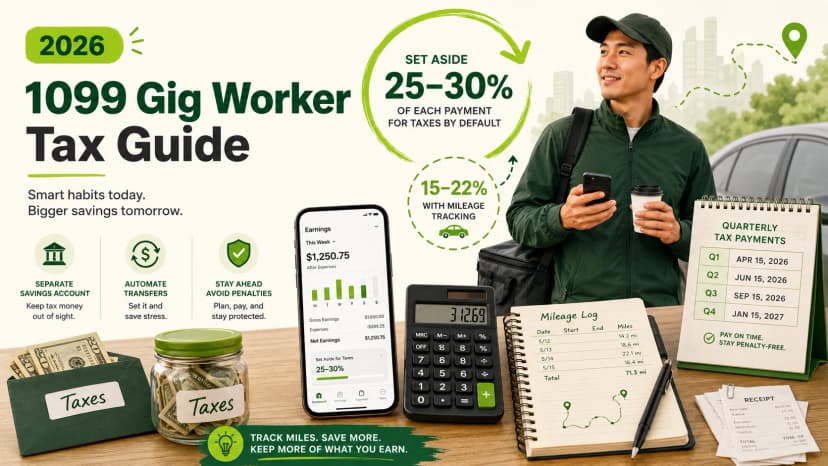
- Set aside 25-30% of every gig payment by default — it covers self-employment tax (15.3%) plus federal income tax for most filers.
- If you track every business mile at the 2026 IRS rate of 72.5¢/mile (January–June) and 76¢/mile (from July 1), the real number drops to 15-22% because the mileage deduction shrinks your taxable income.
- Quarterly estimated payments are due April 15, June 15, September 15, and January 15 — the IRS charges an underpayment penalty if you owe more than $1,000 at filing.
- MFJ couples with a W-2 spouse can lean on the spouse's withholding; HoH single parents can set aside less due to wider brackets + Child Tax Credit.
- Use a separate savings account that auto-transfers your tax % from every gig payment — the operators who get audited rarely have the cash on hand.

See your real hourly rate after car costs.


Table of Contents
Most 1099 gig workers should set aside 25-30% of every payment for taxes, but if you diligently track business mileage at the 2026 IRS rate (72.5¢ per mile for January–June, 76¢ from July 1), the real number drops to 15-22%. The gap between those two numbers is the mileage deduction working in your favor. After running my own numbers on 42,000+ Lime tasks over almost 4 years, I've watched too many drivers either underprepare (and get hit with a $5,000+ tax bill in April) or over-set-aside (and let the IRS sit on $4,000 of refund money for 8 months interest-free). Here's the actual math for 2026, plus the rule of thumb you can use without doing every calculation yourself.
The Quick Rule of Thumb: 25-30% of Every Payment
If you want a single number to live by, set aside 25% to 30% of every gig payment the moment it hits your account. Move it to a separate "Taxes" savings account so you don't accidentally spend it.
This rule covers three tax components for most gig workers earning $20,000-$60,000 in net profit:
- Self-employment tax: 15.3% of net SE earnings (Social Security 12.4% + Medicare 2.9%)
- Federal income tax: 0-12% effective rate after the mileage deduction and standard deduction (varies by filing status and bracket)
- State income tax: 0-13% depending on where you live (zero in TX, FL, NV, WA, TN, AK, SD, WY, NH)
For a full-time gig worker in a state with no income tax, 25% is usually enough. For a worker in California, New York, or another high-tax state, lean toward 30%. Set the number and forget it. At the end of the year, you'll either owe nothing or get a small refund.
The Real Math: Why It's Actually Lower If You Track Mileage
The 25-30% rule is a safe default for someone who doesn't track every business mile. But if you do track miles, the actual math comes out lower because the IRS standard mileage deduction at 72.5¢ per business mile through June 30 and 76¢ from July 1, 2026 directly reduces your taxable income.
Here's a concrete example. Take a full-time DoorDash driver in Texas (no state income tax) earning $48,000 gross with 18,000 business miles in 2026, split evenly across the year (9,000 before July 1, 9,000 after):
- Gross 1099 income: $48,000
- Mileage deduction ((9,000 × $0.725) + (9,000 × $0.76); IRS rate): −$13,365
- Other business expenses (phone, bags, supplies): −$1,800
- Net Schedule C profit: $32,835
- Self-employment tax (15.3% × 92.35% × $32,835): $4,639
- Federal income tax (single filer, $16,100 standard deduction, half of SE tax deducted; IRS): $1,482
- State income tax (Texas = $0): $0
- Total annual tax: $6,121
$6,121 ÷ $48,000 gross = 12.8% effective tax rate. That driver only needs to set aside ~13% of every payment to cover the full tax bill, because the 25-30% rule would have over-set-aside by roughly $5,900. (This example is illustrative: it ignores the qualified business income deduction and assumes the 18,000 miles split evenly between the two 2026 rates.)
The same driver in a state with an income tax would owe more, depending on the state.
The takeaway: tracked mileage is the single biggest lever between "I should set aside 30%" and "I can safely set aside 20%." A driver who doesn't track mileage pays tax on much more of the same income.
Your 2026 Quarterly Payment Schedule
Self-employed gig workers don't have an employer withholding taxes, so you owe them quarterly. The IRS deadlines for the 2026 tax year:
- Q1 (Jan-Mar income): Due April 15, 2026
- Q2 (Apr-May income): Due June 15, 2026
- Q3 (Jun-Aug income): Due September 15, 2026
- Q4 (Sep-Dec income): Due January 15, 2027
Pay via IRS Direct Pay (free), EFTPS (free), or by credit card (a processing fee applies). Most full-time gig workers pay roughly 1/4 of their estimated annual tax each quarter, recalculating after a big month.
The underpayment penalty trigger: If you owe more than $1,000 in federal tax at filing time AND you didn't pay enough quarterly, the IRS charges an underpayment penalty at its underpayment interest rate (7% in the first quarter of 2026; IRS). The safe harbor is to pay either 100% of last year's total tax (110% if AGI > $150,000) OR 90% of this year's owed tax across the four quarters.
How Your Filing Status Changes the Number
The 25-30% rule of thumb works for single filers. For other filing statuses, the math shifts in your favor.
Married Filing Jointly (MFJ): Lean on Your Spouse's W-2 Withholding
If your spouse has a W-2 job, their employer withholds taxes from each paycheck. That withholding covers most of the federal income tax for your combined household, so you only need to cover the SE tax (15.3%) on your gig income plus a small piece of the federal income tax for the gig portion.
A typical MFJ couple with one W-2 spouse ($65K) and one gig worker ($45K with 18,000 miles): the gig worker only needs to set aside 15-18% of every payment for quarterly estimates. The W-2 withholding does the heavy lifting on federal income tax. See our 1099 tax calculator for the MFJ scenario worked out step by step.
Head of Household: Wider Brackets + Child Tax Credit
Single parents with at least one qualifying dependent file as HoH instead of Single. The standard deduction is larger ($24,150 vs $16,100 for Single in 2026; IRS) and the brackets are wider. Plus the Child Tax Credit (up to $2,200 per qualifying child for tax year 2025; IRS) can wipe out the federal income tax portion entirely.
A typical HoH gig driver earning $52,000 with 22,000 business miles pays only about 11% effective tax. Set aside 15% of every payment and you'll have a small refund at filing.
Self-Employed With No Side Income: The Standard Single Case
Full-time gig worker, single filer, no W-2 job, no spouse with income. This is the most common situation and where the 25-30% rule applies. Set aside 25% in low-tax states, 30% in high-tax states, and you're covered.
Why Most Drivers Get This Wrong
Five mistakes I see repeatedly in driver communities:
- "I'll just save it at the end of the year." Doesn't work. By December, the money has been spent. The drivers who don't fail at this all have automatic transfers to a separate savings account.
- Forgetting that the IRS standard mileage rate is 2026, not 2025. The 2026 rate is split: 72.5¢ per mile for January–June and 76¢ from July 1 (up from 70¢ in 2025). Make sure your records use the current rate: historical rates only apply to the year you drove. See our historical IRS mileage rate guide for prior years if you're amending old returns.
- Mixing up gross 1099 income with net taxable income. A $50,000 gross gig year doesn't mean $50,000 in taxable income. After mileage and expenses, taxable income drops to $30,000-$40,000 for most drivers. Tax math should be done on net, not gross.
- Skipping the 1/2 SE tax deduction. Half of your self-employment tax is deductible above-the-line on Schedule 1. Tax software usually catches this; manual filers often miss it. See our guide to calculating AGI as a gig worker for the full above-the-line walkthrough.
- Setting aside the same percentage in every state. A 25% set-aside in Texas (no state tax) is way over-prepared. A 25% set-aside in California (up to 13.3% state tax) might leave you short. Adjust by state.
The System I'd Recommend
Three steps that solve the "I never have the money in April" problem permanently:
- Open a separate "Taxes" savings account (any free high-yield account works, e.g. Ally, Marcus, SoFi). Don't connect a debit card.
- Set up automatic transfers: every time a gig platform deposits to your checking account, move 20% (low-tax state) or 25% (high-tax state) to the Taxes account. Most banks let you automate this on a percentage-of-deposit basis.
- Pay quarterly from the Taxes account: IRS Direct Pay accepts ACH transfers free of charge. After paying, the leftover stays in the account as buffer for the next quarter or refund.
The drivers who run this system never owe a surprise tax bill. The drivers who skip it almost always do. See our quarterly tax estimator for a live calculator that shows you exactly how much to set aside this quarter based on your actual income to date.
Frequently Asked Questions
How much should I set aside for taxes as a 1099 gig worker?
Set aside 25-30% of every gig payment if you don't track business mileage. If you do track mileage at the 2026 IRS rate (72.5¢ per mile through June, 76¢ from July 1), lower it to 15-22%. The exact number depends on your filing status (single/MFJ/HoH), state income tax rate, and total income. Most single full-time gig workers in no-tax states (Texas, Florida, Nevada) can safely set aside 18-22% if they track mileage diligently.
Do I really need to pay quarterly taxes as a gig worker?
If you expect to owe more than $1,000 in federal tax for the year (most full-time gig workers do), yes, and quarterly payments avoid an underpayment penalty. The safe harbor: pay either 100% of last year's tax bill (110% if AGI > $150,000) OR 90% of this year's estimated tax across four quarterly payments. Part-time gig workers earning under $5,000/year usually fall under the $1,000 threshold and don't need to pay quarterly.
What percentage do most gig workers actually pay in taxes?
In the Texas worked example above (single filer, $48,000 gross), the effective federal rate (SE tax + federal income tax combined) came to about 12.8% after the mileage deduction (miles split evenly across the two 2026 rates). Your own rate depends on your income, filing status and expenses. The rule-of-thumb 25-30% set-aside is intentionally conservative, because it overshoots for tracked-mileage drivers in low-tax states.
How does the mileage deduction affect what I should set aside?
The 2026 IRS standard mileage rate (72.5¢ per business mile through June, 76¢ from July 1) reduces your Schedule C net profit, which reduces both federal income tax AND the 15.3% self-employment tax. A driver logging 20,000 business miles, split evenly across the year, claims $14,850 in deductions ((10,000 × $0.725) + (10,000 × $0.76)), which at 14.1% SE tax plus a 12% to 22% income tax bracket is roughly a $3,900 to $5,400 reduction in federal tax owed. That's why a tracked-mileage driver can set aside 20% safely while an untracked driver needs 30%. See our IRS mileage deduction guide for the full mechanics.
What if I have a W-2 job AND gig income?
Your W-2 employer withholds federal income tax automatically. To cover your gig income's tax bill, the simplest path is to either: (1) increase your W-2 withholding via Form W-4 (add an "extra withholding" amount on line 4(c) equal to ~25% of your expected gig income), or (2) pay quarterly estimated taxes on the gig portion only. Most accountants prefer option 1 because it's simpler and avoids quarterly deadlines.
Can I deduct anything beyond mileage to lower my tax bill?
Yes. Other deductible expenses for 1099 gig workers: business-use percentage of your cell phone, hot/insulated bags, supplies, platform fees, parking fees (not tickets), tolls, accounting software, self-employed health insurance premiums (above-the-line on Schedule 1), and SEP-IRA or Solo 401(k) retirement contributions. See our tax write-offs guide for gig workers for the complete checklist.
What happens if I don't set aside enough?
At tax filing in April, you owe the IRS the difference. If the amount owed exceeds $1,000 AND you didn't pay enough quarterly estimates, the IRS charges an underpayment penalty at its underpayment interest rate (7% in the first quarter of 2026; IRS). You can also set up a payment plan if you can't pay all at once. But the cleaner path is to never get there: set aside money from every payment so April is just an admin task, not a financial crisis.
Founder of ShiftTracker. Lime LP for almost 4 years · 42,000+ tasks completed. Background in financial trading and behavioral optimization.
You Might Also Like
Is Wingz Worth It for Drivers in 2026? (NEMT Pay, Requirements, Reviews)
Wingz driver work in 2026 is mostly NEMT: weekday rides to dialysis and other appointments. Trips ar...
Is MedZoomer Worth It for Drivers in 2026? (Pay, Reviews, Requirements)
MedZoomer reviews from couriers average 2.6 stars on Indeed and the App Store. It pays per delivery ...
Is TaskRabbit Worth It in 2026? (Tasker Pay, Fees, Real Hourly)
TaskRabbit taskers set their own rate, keep all of it plus tips, and pay a one-time $25 fee. The cat...