DoorDash Earnings Calculator (2026)
By Brenden Warn, Founder & Gig Economy Analyst
See what you really make per hour after gas, mileage, and expenses. Free calculator built for Dashers using the 2026 IRS mileage rate.
DoorDash Earnings Calculator
Effective hourly rate: $26.94/hr
ShiftTracker calculates this automatically for every delivery.
How to Calculate True DoorDash Earnings
Log Every Dash
Track base pay, tips, Peak Pay bonuses, and Quest completions for every order.
Track All Miles
Record total miles driven from dash start to dash end - not just the paid delivery miles.
Apply the 2026 IRS Rate
Deduct $0.725 per mile for miles driven January-June and $0.76 per mile from July 1. This covers gas, maintenance, insurance, and depreciation.
Reserve for Self-Employment Tax
Set aside 15.3% of net pay for SE tax plus your income tax bracket to avoid quarterly surprises.
What ShiftTracker Tracks for Dashers
All Earnings Sources
- Base pay per delivery
- Customer tips
- Peak Pay bonuses
- Quest and Challenge rewards
Expense Tracking
- Gas and charging
- Automatic mileage logging
- Hot bag / phone mount / gear
- Vehicle depreciation
Analytics
- True net hourly rate
- Peak window heatmap
- Platform comparison
- Weekly / monthly trends
DoorDash Pay Structure Explained
Base Pay: Varies per order by distance, duration, and desirability. Check the payout shown before you accept.
Peak Pay: A per-order bonus during high-demand windows. Check the Dasher app Peak Pay map before starting.
Tips: 100% of customer tips go to you.
Challenges: Complete X deliveries in Y hours for bonus pay. Check whether a Challenge stacks with Peak Pay before you chase it.
Ratings: DoorDash's Dasher Ratings page lists a 4.2 minimum customer rating and a 90% minimum completion rate, with no minimum acceptance rate. Rewards tiers and perks have their own thresholds, which DoorDash changes over time, so check its current rules.
DoorDash Driver FAQs
How much do DoorDash drivers really make per hour?
DoorDash drivers make $13-$20/hour net on average in 2026 after gas, mileage, and vehicle depreciation. Top drivers who restrict themselves to peak windows (lunch, dinner, and Friday/Saturday late night) consistently earn $22-$28/hour. ShiftTracker shows your true hourly rate automatically.
How do I calculate my DoorDash earnings after expenses?
Start with gross pay (base + tips + Peak Pay), then subtract gas (~$0.15/mi), mileage deduction at the 2026 IRS rate of $0.76/mile (July 1, 2026 onward), maintenance (~$0.08/mi), and a self-employment tax reserve of 15.3%. ShiftTracker calculates all of this per delivery.
What is Peak Pay on DoorDash?
Peak Pay is a per-order bonus DoorDash adds during high-demand windows (weather events, holidays, understaffed zones). It ranges from $1 to $8 per order and is the single biggest factor in $30+/hour shifts. Check the Peak Pay map in your Dasher app before you start.
What is the best time to DoorDash for maximum earnings?
Dinner rush (5pm-9pm) on Friday and Saturday pays the most per hour on DoorDash, followed by weekend late nights (10pm-1am) in bar/college markets. Weekday lunch (11am-1pm) is the strongest daytime window. See our full guide for hour-by-hour breakdowns.
Does DoorDash pay for gas?
No, DoorDash does not reimburse fuel costs directly. However, the IRS mileage deduction of $0.76/mile (from July 1, 2026; $0.725 for January-June) effectively covers gas plus maintenance at tax time. Tracking every mile - not just paid miles - is critical to claim the full deduction.
Know Your True DoorDash Earnings
Stop driving blind. Start tracking your real Dasher profits with ShiftTracker.


Related from the Blog
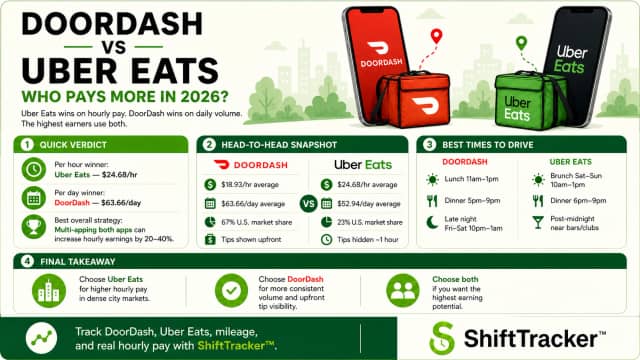
Uber Eats vs DoorDash Pay 2026: Real $/Hour Comparison ($24.68 vs $18.93)
Uber Eats pays drivers $24.68/hr versus DoorDash's $18.93/hr per Gridwise Analytics data (2023 Q1 to 2024 Q2). But DoorDash wins on daily volume with 67% market share. Here's which app actually pays more in your market, and why most top-earning drivers run both.
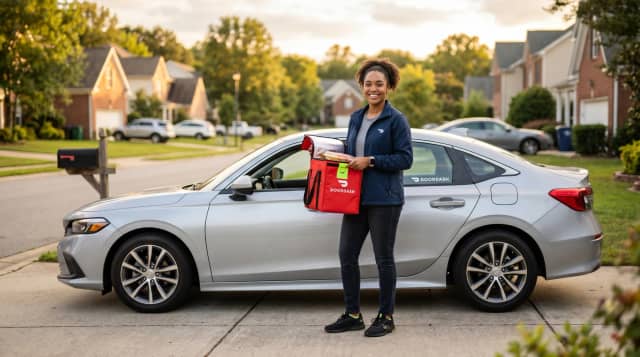
How to Become a DoorDash Driver in 2026: Complete Signup Guide
Everything you need to sign up as a Dasher in 2026: age and vehicle requirements, the 4-step application process, background check timeline, realistic pay expectations, and the 30-minute Day 1 setup that helps new drivers keep more at tax time.
