Instacart vs DoorDash Pay Comparison (2026): $16-24/hr vs $15-22/hr
By Brenden Warn, Founder & Gig Economy Analyst · Updated May 2026
Instacart shoppers gross $16-24/hour vs DoorDash drivers at $15-22/hour in 2026 — Instacart edges out by $1-2/hour on average, mostly because grocery batches carry higher tips and bigger order values. But the choice isn't just about hourly pay: per-batch earnings, physical effort, schedule flexibility, mileage volume, and tax treatment all differ meaningfully. Here's the side-by-side that actually matters.
Side-by-Side Comparison
Real 2026 figures across both platforms, based on driver-reported data from r/InstacartShoppers, r/doordash_drivers, and Indeed self-reports.
| Factor | Instacart | DoorDash | Winner |
|---|---|---|---|
| Gross $/hour (avg) | $16-24 | $15-22 | Instacart |
| Net $/hour (after expenses) | $12-18 | $12-17 | Tie |
| Avg per-batch / per-order pay | $20-60 (1-3 orders) | $5-12 (1 order) | Instacart |
| Avg tip per delivery | $8-15 (predictable) | $3-5 (predictable) | Instacart |
| Time per task | 30-60 min (in-store + delivery) | 15-25 min (pickup + delivery) | Different work styles |
| Physical effort | High (walking, lifting) | Low (mostly driving) | DoorDash |
| Miles per active hour | 5-10 miles | 8-15 miles | Diff use cases |
| 2026 IRS mileage deduction | $0.76/mi (Jul 1, 2026+) | $0.76/mi (Jul 1, 2026+) | Same rate |
| Peak earning windows | Weekend mornings, weekday 3-6 PM | Fri/Sat dinner, late night | Complementary |
| On-demand flexibility | Limited (best batches scheduled) | Full on-demand | DoorDash |
| Vehicle requirements | Larger trunk preferred | Any working vehicle | DoorDash |
| Multi-app friendly | Difficult (long batches) | Easy (short orders) | DoorDash |
Pay Deep Dive: How the $/Hour Math Actually Works
Instacart per-batch math
A typical Instacart batch contains 1-3 customer orders shopped in a single store visit. Pay breaks down as: base pay ($7-$15 per batch depending on size, complexity, and item count), tips ($8-$15 per batch average, pre-selected by customer at checkout), and occasional Peak Boost ($1-$5 bonus during high-demand windows).
Median per-batch pay in 2026: roughly $25-$35. Top earners cherry-pick batches paying $40-$60+ during weekend mornings in family-heavy suburbs. Bad batches (single small order at low pay) get rejected — Instacart's algorithm shows you the offer before you accept, so you have full price transparency.
Per-hour math: 30-45 minutes per batch × ~$30 average = roughly $20/hour gross active time. Including time spent waiting for next batch acceptance, the realistic hourly rate lands at $16-24/hour.
DoorDash per-delivery math
A typical DoorDash delivery: base pay ($2-$6 per delivery, scaled by distance and order desirability), tip ($3-$5 average, shown upfront), and optional Peak Pay ($1-$4 per order during surge windows).
Median per-delivery pay in 2026: $7-$10 including tip. Top earners working Friday/Saturday dinner peaks in dense markets clear $12-$18 per delivery. The volume model works because deliveries are short — 15-25 minutes each — so a steady 3-4 deliveries per hour can clear $25-$35/hour gross.
Per-hour math: 3-4 deliveries × $8 average = $24-$32/hour gross during peak windows; $15-$20/hour gross during slower windows. National average across all hours: $15-$22/hour gross.
After expenses: why both end up at $12-$18/hour net
The headline gross numbers obscure that both platforms net out roughly the same after expenses. For each gross dollar earned:
- •~12-18% goes to gas + maintenance (at 2026 IRS rate $0.76/mile (July 1, 2026 onward), this is partially offset by tax deduction)
- •15.3% goes to self-employment tax (Social Security + Medicare, both halves)
- •10-22% goes to federal income tax (depending on filing status and bracket — see our 1099 tax calculator for your specific numbers)
- •0-13% goes to state income tax (zero in TX/FL/etc; up to 13% in California)
DoorDash drivers have slightly higher gas costs per hour because they log more miles per active hour. Instacart shoppers have slightly higher physical wear costs (footwear, knee/back strain over time) but lower vehicle wear. Net out, both land at $12-$18/hour real take-home for typical drivers, with the IRS mileage deduction at $0.76/mile (July 1, 2026 onward) being the single largest tax-side lever for either.
Which Should You Pick? Use-Case Breakdown
- ✓Want higher per-trip pay ($25-$60 per batch)
- ✓Have a larger trunk (SUV, hatchback, minivan)
- ✓Are physically fit and don't mind walking/lifting
- ✓Prefer predictable tip income (pre-tip at checkout)
- ✓Can commit to weekend morning shifts (4-8 hour blocks)
- ✓Want to drive fewer miles per hour (lower vehicle wear)
- ✓Want pure on-demand flexibility (log on whenever)
- ✓Have a smaller vehicle (sedan, coupe, motorcycle)
- ✓Prefer shorter, faster trips (15-25 min each)
- ✓Want to multi-app with Uber Eats or Grubhub
- ✓Have physical limitations (back/knee issues)
- ✓Want to maximize the 2026 IRS mileage deduction ($0.76/mile (July 1, 2026 onward) — DoorDash logs more miles per active hour)
The Multi-App Strategy: Instacart + DoorDash + Time-Shifting
Most top-quartile gig drivers don't pick ONE platform — they run both Instacart and DoorDash at different times of day. The key insight: their peak demand windows are complementary, not competing.
Recommended weekly structure for someone running both:
- Sat 9 AM-1 PMInstacart morning peak — weekend grocery rush, family orders, highest per-batch tips
- Weekday afternoonsInstacart dinner-prep window (3-6 PM) — moderate volume, predictable tips
- Fri/Sat 5:30-9 PMDoorDash dinner peak — restaurant rush, surge multipliers, high tip frequency
- Fri/Sat 10 PM-1 AMDoorDash late-night nightlife — drunk-and-hungry customers, strong tips
A driver running this schedule typically adds 20-30% to weekly earnings vs running just one platform, because each peak window is targeted with the platform that's actually busy. The trade-off: more apps to manage, more vehicle wear, more mileage to track. ShiftTracker captures shifts platform-agnostically so all your business miles roll into a single Schedule C summary at tax time, claimable at the 2026 IRS rates (72.5 cents per mile for January-June, 76 cents from July 1).
Frequently Asked Questions
Does Instacart or DoorDash pay more in 2026?
Which app pays more per delivery — Instacart or DoorDash?
What is the average pay for Instacart vs DoorDash in 2026?
Which is harder physically — Instacart or DoorDash?
Can I do Instacart and DoorDash at the same time?
Which platform has better tips — Instacart or DoorDash?
Which platform has better tax deductions in 2026?
Should I drive for Instacart or DoorDash if I want flexibility?
Track Both Platforms Side by Side
ShiftTracker logs Instacart batches and DoorDash deliveries platform-agnostically — odometer-based mileage at shift start and end (the format IRS Publication 463 specifically asks for), real hourly rate after expenses, and a unified Schedule C summary at tax time.


Related from the Blog
Is Instacart Worth It in 2026? Real Shopper Earnings and the Honest Answer
Instacart pays $18-$26/hour net in 2026 for full-service shoppers in high-income suburbs, but drops to $13-$16/hour in saturated markets. Here is an honest breakdown of who should shop and who should skip it.
Is DoorDash Worth It in 2026? Real Dasher Earnings and the Honest Answer
DoorDash pays $13-$20/hour net for most drivers in 2026, but top earners working peak windows clear $22-$28/hour. Here is an honest breakdown of who should dash and who should skip it.
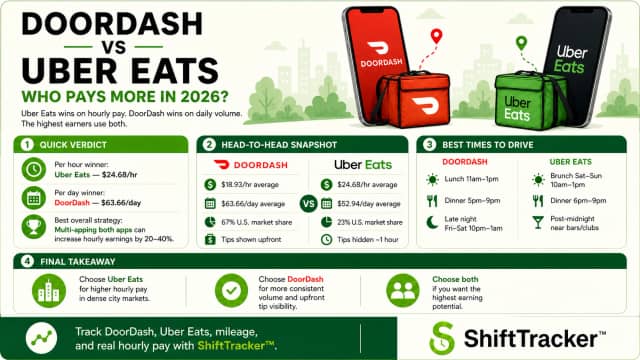
Uber Eats vs DoorDash Pay 2026: Real $/Hour Comparison ($24.68 vs $18.93)
Uber Eats pays drivers $24.68/hr versus DoorDash's $18.93/hr per Gridwise Analytics data (2023 Q1 to 2024 Q2). But DoorDash wins on daily volume with 67% market share. Here's which app actually pays more in your market, and why most top-earning drivers run both.
