Is DoorDash Worth It in 2026? Real Dasher Earnings and the Honest Answer
The Short Answer
- DoorDash pays $13-$20/hour net for the average dasher in 2026
- Top earners working peak windows + multi-apping clear $22-$28/hour
- Worth it if you work Fri/Sat dinner and late-night bar rushes
- Skip it if you only have weekday daytime or Monday-Tuesday hours
- Cherry-picking at $2/mile is the single biggest lever on take-home

See your real hourly rate after car costs.


Table of Contents
Is DoorDash Worth It in 2026? The Short Answer
DoorDash is worth it in 2026 if you can work Friday/Saturday dinner rushes, multi-app with Uber Eats or Walmart Spark, and cherry-pick only orders above $2 per mile. Drivers who do all three consistently earn $22-$28/hour net after gas and mileage. For the average dasher who accepts every order and works random hours, real net pay drops to $13-$20/hour and the job stops being worth the vehicle wear.
The gap between top earners and average dashers on DoorDash is wider than most gig apps - almost entirely driven by tactics rather than effort. This guide gives you the honest breakdown of who should dash, who should skip it, and what "worth it" actually means in 2026.
Real DoorDash Earnings in 2026
DoorDash pay comes from four sources: base pay (what DoorDash pays per order), customer tips (base pay covers about 42 to 43 percent of a typical trip's total payout, so tips are most of the rest; Gridwise, 2025), Peak Pay bonuses during high-demand windows, and Challenge/Quest completion rewards. The ratio between those sources is what separates $14/hour drivers from $28/hour drivers.
| Dasher Type | Typical Net $/hr | Key Driver | Schedule |
|---|---|---|---|
| Casual weekend dasher | $18-$24 | Friday/Saturday dinner + late night | 10-15 hrs/week |
| Part-time multi-app | $20-$26 | Stacking with Uber Eats + Spark | 20-30 hrs/week |
| Full-time grind (no cherry-picking) | $13-$18 | Accepts every order | 40-50 hrs/week |
| Full-time optimized | $22-$28 | Cherry-picks + peak windows + multi-apping | 35-40 hrs/week |
| Top Dasher grinder | $15-$20 | 70% acceptance for Dash Anywhere | 30-45 hrs/week |
Those numbers are net after gas and before taxes. Apply the 2026 IRS mileage rate ($0.725 per mile through June, $0.76 per mile from July 1) to see your tax-time picture - mileage is the single biggest deduction for dashers.
DoorDash Pros: Why Dashers Stick With It
1. Highest Order Volume in Food Delivery
DoorDash held approximately 67% of the US food delivery market in 2025 (Statista via Deliverect). That translates directly into more orders per hour than Uber Eats, Grubhub, or Instacart in almost every market. More order flow means less idle time between deliveries, which is the #1 determinant of hourly pay.
2. Schedule Flexibility Is Genuinely Unlimited
Unlike Instacart (weekend-heavy) or Walmart Spark (weekday lunch windows), DoorDash lets you dash profitably at almost any hour if your market has volume. Weekday lunch, weekday dinner, weekend nights, and late-night bar rushes all work. The only truly dead windows are 2pm-4pm and Monday dinners.
3. Peak Pay Bonuses Are Transparent
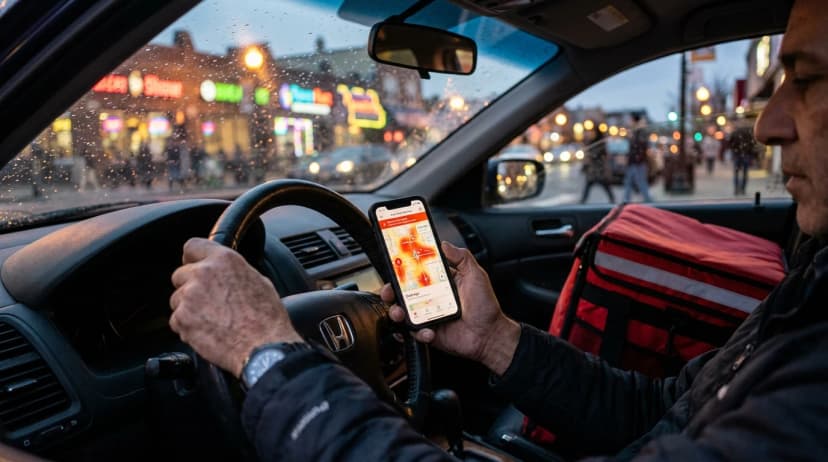
DoorDash's Peak Pay map shows exactly which zones are offering extra per-order bonuses right now. You can see the bonus on the map, move into the zone, and capture it. Competitor Uber Eats' boost system is less transparent and slower to react.
4. Bad Weather Is a Goldmine
Rain, snow, and cold snaps can trigger Peak Pay bonuses while cutting driver competition. Storm shifts can be some of the best-paying hours you'll see. Drivers who show up when others stay home win big.
5. Fast Onboarding and Activation
DoorDash approves new dashers within 24-48 hours in most markets, and you can start accepting orders the same day activation clears. Compared to Instacart (5-10 day approval) or Amazon Flex (waitlists in many markets), DoorDash is the fastest path from "I want to try this" to "I just made $50."
DoorDash Cons: Why Dashers Quit
1. Base Pay Alone Does Not Work
DoorDash's base pay per order has trended down since 2020, and many orders now pay $3-$5 in base before tips. If tips do not flow, the math collapses. Drivers who accept every order without cherry-picking typically earn $13-$16/hour net, which often does not cover gas and depreciation.
2. Tips Are Sometimes Hidden
DoorDash's "tip suggestion" system occasionally hides full tip amounts until after delivery, showing you only a minimum guaranteed pay. This is improving but still happens, making it harder to cherry-pick accurately.
3. Contract Violations Feel Arbitrary
"Lateness" and "not delivered" contract violations can be triggered by factors beyond your control (slow restaurants, customer complaints, GPS errors). Three violations in 100 deliveries and you risk deactivation. The review process is opaque.
4. Market Saturation Hits Big Metros Hard
NYC, LA, Chicago, and San Francisco are oversaturated with dashers competing for the same orders. In these markets, real net pay routinely drops to $12-$15/hour and Peak Pay bonuses are diluted. Suburban and mid-sized markets are significantly more profitable than major metros.
5. Vehicle Wear Is Real
Full-time dashers log a lot of miles. At that pace, a 5-year-old sedan depreciates faster than the IRS standard mileage rate compensates. If you are driving a vehicle you plan to resell, the true cost of dashing is higher than most drivers calculate.
Who Should Dash DoorDash in 2026
- You can work Friday/Saturday evenings. Weekend dinner rush (5pm-9pm) plus late-night bar rush (10pm-1am) is where the real money is. 15 hours on Friday/Saturday out-earns 30 hours on Mon-Wed.
- You are willing to cherry-pick and maintain a low acceptance rate. The $2/mile rule protects your hourly. Chasing Top Dasher status via 70% acceptance typically costs more than it earns.
- You live in a mid-sized suburban market. Markets with populations of 100k-500k outperform major metros on per-hour pay because they combine volume with lower driver competition.
- You want to multi-app. DoorDash pairs exceptionally well with Uber Eats and Walmart Spark. Running two apps simultaneously can raise hourly pay without adding mileage proportionally.
- You have a fuel-efficient or paid-off vehicle. The math works when gas and depreciation stay under $0.15-$0.20/mile. Gas-guzzlers or vehicles with active loans eat too much of the take-home.
- You need fast activation money. DoorDash's 24-48 hour onboarding is the fastest in food delivery - ideal for bridging income gaps.
Who Should Skip DoorDash in 2026
- You can only work weekdays 8am-5pm. DoorDash weekday daytime pays significantly less than evenings. Walmart Spark or Instacart in-store pay more during those windows.
- You live in an oversaturated metro. NYC, LA, SF, and parts of Chicago have too many dashers chasing too few orders. Consider Uber rideshare in those markets instead.
- You drive a gas-guzzling SUV or truck. DoorDash's per-mile economics break when fuel costs exceed $0.25/mile. If your vehicle gets under 20 mpg, skip DoorDash for rideshare or in-store delivery.
- You need predictable scheduling. Unlike Amazon Flex's block-based system, DoorDash is "log in and hope." If you need to know exactly how much you will earn in advance, dash is not the right gig.
- You cannot handle customer service stress. Rating maintenance requires consistent 5-star service, clear communication, and emotional steadiness when customers are rude. If that is not your strength, Amazon Flex or in-store grocery gigs reduce customer contact.
DoorDash vs Other Gig Apps: Honest Comparison
How DoorDash stacks up against the other major gig platforms for a driver evaluating where to spend their time in 2026:
| Platform | Net $/hr | Volume | Best For |
|---|---|---|---|
| DoorDash | $13-$20 (up to $28 optimized) | Highest | Flexible schedule, multi-app base |
| Instacart | $18-$26 | Medium-High | High-income suburbs, weekend shoppers |
| Walmart Spark | $15-$22 | High (suburbs) | Weekday 10am-2pm windows |
| Uber Eats | $13-$19 | High (urban) | Dense urban food delivery, multi-app with DoorDash |
| Grubhub | $13-$19 | Low-Medium | Markets with exclusive campus contracts |
For complete rankings with context, see our Top 10 highest-paying gig apps in 2026 guide. Or compare DoorDash head-to-head with its biggest rival in our DoorDash vs Uber Eats 2026 pay breakdown.
How to Maximize DoorDash Earnings If You Decide to Try It
- Cherry-pick using the $2/mile rule. Reject any offer paying less than $2 per combined pickup+delivery mile. This single rule is the difference between $14/hour and $22/hour for most drivers.
- Concentrate hours Wed-Sun evenings. Monday and Tuesday are structurally the weakest DoorDash days. Schedule your 35-40 hours between Wednesday and Sunday, with heavy focus on Friday and Saturday dinner + late night.
- Multi-app with Uber Eats. Run both simultaneously; accept second orders only when pickups are within 0.5 miles of your current delivery. Multi-apping fills the gaps between offers.
- Reposition to restaurant-dense zones every 15 minutes. Sitting in one spot limits your order pool. Rotating between 3 high-volume hubs on a 15-minute timer maximizes offers per hour.
- Check the Peak Pay map every 10-15 minutes. When a zone lights up red or orange, move into it immediately - Peak Pay bonuses only pay while you are physically in the zone.
- Work bad weather. Rain, snow, and cold snaps are the highest-paying windows of the year. A 4-hour storm shift often pays more than a full day of normal dashing.
- Switch to Walmart Spark for weekday 10am-2pm. DoorDash dies during weekday lunch; Spark peaks. See our DoorDash slow market tactics guide for the full switching playbook.
- Track your real hourly rate. Use ShiftTracker to log every dash, mileage, and net take-home. Most drivers discover their best hours are not the ones they assumed.
Frequently Asked Questions
How much do DoorDash drivers really make in 2026?
Average DoorDash drivers earn $13-$20/hour net after gas and mileage in 2026. Top earners who cherry-pick using the $2/mile rule, work Friday/Saturday peak windows, and multi-app with Uber Eats consistently clear $22-$28/hour. Full-time grinders who accept every order often earn only $14-$17/hour despite working more hours.
Is DoorDash worth it in 2026 compared to other gig apps?
DoorDash has the highest order volume in food delivery (67% US market share) but Instacart and Walmart Spark often pay more per hour in the right markets. The best strategy is running DoorDash alongside Uber Eats for dinner rushes and switching to Walmart Spark for weekday lunch windows.
Can you really make $1,000 a week on DoorDash?
Yes, but not by accepting every order and working random hours. $1,000/week requires 35-40 hours concentrated in peak windows (Wed-Sun dinner + Fri/Sat late night), cherry-picking at $2/mile or higher, and often multi-apping with Uber Eats. Drivers grinding 50+ hours at low acceptance rates typically hit $700-$800/week.
Is DoorDash worth it as a side hustle?
Yes, if you can work Friday and Saturday evenings. A 10-15 hour weekend shift focused on dinner rush (5pm-9pm) and late-night bar crowd (10pm-1am) typically nets $300-$500 after expenses. Side hustlers who can only work weekday daytime earn far less.
Is Top Dasher worth it in 2026?
For most drivers no. Top Dasher requires maintaining 70% acceptance rate, which forces you to accept low-paying orders that drag down your hourly rate. The benefit - Dash Anywhere on demand - is useful in some markets but usually does not make up for the lost per-hour pay from cherry-picking. Skip Top Dasher unless your market specifically rewards it.
Does DoorDash pay for gas?
No, DoorDash does not reimburse fuel costs directly. However, the 2026 IRS mileage deduction of $0.76 per mile (July 1, 2026 onward) effectively covers gas plus maintenance at tax time. Track every mile from app-on to app-off to claim the full deduction - this is typically the single largest tax write-off for full-time dashers.
Is DoorDash slow in 2026?
Slowness varies dramatically by market and window. Weekday 2pm-4pm and Monday dinners are structurally slow everywhere. Oversaturated major metros (NYC, LA, SF) are slow across most windows due to too many drivers. Mid-sized suburban markets remain strong. See our DoorDash slow market tactics guide for how to earn in dead zones.
How many hours do I need to dash per week to make DoorDash worth it?
15-20 hours per week concentrated in Friday/Saturday evenings is the sweet spot for side hustlers. Full-time dashers should target 35-40 hours in peak windows (Wed-Sun). Anything less than 10 hours per week and the vehicle wear and gas often eat too much of the take-home pay to justify the effort.
Founder of ShiftTracker. Lime LP for almost 4 years · 42,000+ tasks completed. Background in financial trading and behavioral optimization.
You Might Also Like
DoorDash Dasher Rewards and Driver Tiers Explained (2026)
Silver, Gold, Platinum — and what happened to Top Dasher. What each Dasher Rewards tier actually unl...
Can DoorDash Drivers See the Tip Before Accepting? (2026)
Dashers never see a line that says "tip: $8" — but the number on the offer screen already includes i...
Does DoorDash Take Out Taxes? 1099 Forms, Business Codes and What You Actually Owe
DoorDash withholds nothing from your pay: no federal tax, no Social Security, no Medicare. You owe 1...