DoorDash vs Uber Eats vs Grubhub 2026: Which Pays Drivers Most + Lowest Fees
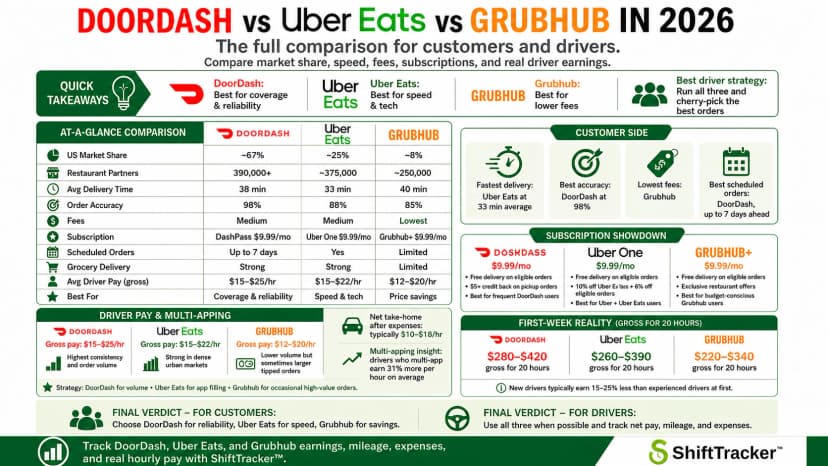
The Short Answer
DoorDash leads US food delivery with ~67% market share (March 2024); Grubhub is a distant third at ~8% after agreeing to a $650M sale to Wonder (announced November 2024)
In the delivery-time figures UpMenu reports (citing Intouch Insight), DoorDash is fastest at about 26 minutes, versus about 36 for Grubhub and 38 for Uber Eats; the study year is not stated
Order accuracy mostly follows the restaurant, and the public summary of Intouch Insight's 2025 mystery-shop study does not rank these three platforms on accuracy
No app is consistently cheapest on fees; all three subscriptions list at $9.99/month (DashPass, Uber One, Grubhub+)
For drivers, running all three platforms and cherry-picking best orders is the highest-earning strategy; Gridwise's 2025 medians run from about $11 to $15 an hour before expenses

Track your shifts smarter
See your real hourly rate after car costs. 7-day free trial on iPhone and Android.
Table of Contents
These three platforms now handle the majority of US restaurant delivery — but they're not interchangeable. DoorDash controlled roughly 67% of the US market in March 2024 and has the widest coverage (Bloomberg Second Measure via Restaurant Dive). Uber Eats is the main rival. Grubhub, now under new ownership after a $650M sale to Wonder Group announced in November 2024, has shrinking reach (TechCrunch, 2024).
Whether you're a customer deciding which app to order from, a driver figuring out where to spend your time, or a restaurant weighing platform partnerships — this comparison covers everything that actually matters in 2026.
Quick Comparison: DoorDash vs Uber Eats vs Grubhub at a Glance
Before going deep on each category, here's the full picture in one table. Every stat below is covered in detail in the sections that follow.
| Category | DoorDash | Uber Eats | Grubhub |
|---|---|---|---|
| US Market Share (March 2024) | ~67% | ~23% | ~8% |
| Avg Delivery Time (UpMenu, citing Intouch Insight) | 26 min ✓ | 38 min | 36 min |
| Fees | Varies by order | Varies by order | Varies by order |
| Subscription | DashPass $9.99/mo | Uber One $9.99/mo | Grubhub+ $9.99/mo |
| Scheduled Orders | Yes | Yes | Limited |
| Grocery Delivery | Strong | Strong | Limited |
| Median Driver Pay per hour (Gridwise, 2025) | ~$11.26 | $14.07 | $15.38 |
| Best For | Coverage & reliability | Tech & Uber ecosystem | Phone ordering |
Delivery Times & Speed Comparison (2026)
DoorDash was the fastest of the three platforms in the figures UpMenu reports, averaging about 26 minutes per delivery, compared with about 36 minutes for Grubhub and 38 minutes for Uber Eats (UpMenu, citing Intouch Insight; the article does not state the study year). Treat these as a rough guide, because speed varies a lot by market.
On those averages DoorDash is about 12 minutes faster than Uber Eats — meaningful at scale but variable by market.That said, averages only go so far. Delivery speed depends heavily on restaurant prep time, which no app controls, and driver density in your specific area. DoorDash's larger driver network can actually make it faster in suburban and rural markets where Uber Eats has fewer active drivers. In dense cities, local conditions can change the picture, so treat any average as a starting point.
UpMenu reports average delivery times of about 26 minutes for DoorDash, 36 minutes for Grubhub and 38 minutes for Uber Eats, citing Intouch Insight (UpMenu; the article does not state the study year). DoorDash's larger overall driver pool may help explain the gap in suburban and lower-density areas.
App Interface & User Experience — Which Is Easiest to Use?
All three apps are mature, well-designed products in 2026 — but they have meaningfully different UX philosophies. DoorDash prioritizes discovery with a clean browse-by-category layout and strong restaurant search. Uber Eats leans on its tech DNA with faster load times, a more polished visual design, and tight integration with Uber's ride-sharing ecosystem. Grubhub has a more functional, less flashy interface that long-time users find efficient — though it's showing its age compared to the other two.
Here's how they compare on the specific UX features that actually affect ordering:
- Search & discovery: DoorDash has the best search functionality — filtering by cuisine, dietary preference, price range, and "fastest delivery" all work reliably. Uber Eats' visual design is slightly cleaner. Grubhub's search is functional but not as refined.
- Scheduled orders: DoorDash leads here — you can schedule deliveries in advance with good reliability. Uber Eats also supports scheduled orders. Grubhub's scheduled ordering is more limited and less consistent.
- Order tracking: Uber Eats has the best real-time tracking interface — the map updates smoothly and the driver ETA is generally accurate. DoorDash is close. Grubhub's tracking is less detailed.
- Reordering past orders: All three make repeat orders easy. DoorDash's "reorder" feature is the most prominent in the UI.
- Accessibility for older users: DoorDash and Uber Eats both offer phone-based customer service and a relatively clean layout for older adults. Grubhub also supports phone ordering, which some seniors prefer over app-based ordering.
The app interface distinction matters most if you order frequently — casual users are unlikely to notice the difference. For people placing 2–3 orders per week, DoorDash's superior filtering and scheduling features tend to save meaningful time.
Order Accuracy & Food Quality
Order accuracy mostly follows the restaurant, not the app. Intouch Insight's 2025 Third-Party Delivery Study ran 600 mystery shops across the US between April and June 2025, with 150 orders on each of Uber Eats, DoorDash and Grubhub (Intouch Insight, 2025). Its public summary does not break accuracy out by platform, so we can't rank the three on accuracy.
Worth keeping in mind: missing items, wrong orders, or food quality problems typically originate at the kitchen, so accuracy follows the restaurant more than the platform. If accuracy matters to you, pay attention to which restaurants get your order right.
Fees, Prices & Cost Comparison
No app is consistently the cheapest; it depends on order size and location. In Cheapism's testing across order sizes, DoorDash service fees started at 60 cents and rose with order total, Grubhub service fees ran from $1.50 to $9, and the small order fee was a flat $2.50 on DoorDash versus $2 on Grubhub for orders under $10.
| Fee Type | DoorDash | Uber Eats | Grubhub |
|---|---|---|---|
| Delivery Fee | $0–$3 in Cheapism's testing | Varies by store and location | $0–$2.49 in Cheapism's testing |
| Service Fee | Starts at 60 cents, rises with order total | Varies with order total | $1.50–$9 in Cheapism's testing |
| Small Order Fee | $2.50 flat | Varies | $2 on orders under $10 |
| Menu Price Markup | Some restaurants | Some restaurants | Some restaurants |
| Subscription | DashPass $9.99/mo | Uber One $9.99/mo | Grubhub+ $9.99/mo |
One thing all three platforms have in common: menu prices at some restaurants are marked up vs in-store. This is the restaurant's choice, not the platform's — but it adds to the total cost regardless of which app you use. If you order frequently, a subscription removes the delivery fee on eligible orders, which can pay for itself quickly.
Which Platform Is Best for Scheduled & Advance Orders?
DoorDash lets you schedule an order ahead at checkout (DoorDash Help) — a meaningful advantage for anyone planning meals ahead or ordering for a specific arrival time.
How scheduled orders work on each platform:
- DoorDash: Schedule deliveries ahead from the checkout page. Reliability is generally solid — the restaurant receives the order with enough lead time to prep. Best of the three for this use case.
- Uber Eats: Also supports scheduled orders. Restaurant availability for scheduling varies more than on DoorDash. Overall solid, slightly less consistent.
- Grubhub: Scheduled ordering exists but is more limited in terms of timing flexibility and restaurant availability. If advance scheduling is a priority, DoorDash is the better choice.
Grocery Delivery: DoorDash vs Uber Eats vs Grubhub vs Instacart
DoorDash and Uber Eats both offer robust grocery delivery through platform partnerships — Grubhub does not compete meaningfully in this category. DoorDash partners with Safeway, Albertsons, Aldi, Walgreens, and others through DoorDash Drive. Uber Eats partners with Costco, Sprouts, and similar retailers in many markets. Both have expanded alcohol delivery through licensed retailers as well.
How do they stack up against Instacart? Instacart remains the dedicated grocery leader — wider retailer selection, more precise substitution preferences, and better produce quality guarantees. DoorDash and Uber Eats are catching up quickly, particularly for convenience store runs and quick grocery top-ups, but for a full weekly grocery haul, Instacart still wins on selection and shopper experience. The gap is closing, though — especially in markets where Instacart coverage is thin.
Market Share & Platform Status in 2026
DoorDash held about 67% of US food delivery sales in March 2024 — more than Uber Eats and Grubhub combined (Bloomberg Second Measure via Restaurant Dive). Uber Eats held about 23%. Grubhub, once valued at $7.3 billion when Just Eat Takeaway acquired it in 2020, held about 8% and was sold to Wonder Group for $650 million in a deal announced in November 2024 (TechCrunch, 2024).
What does the Wonder acquisition mean for Grubhub users? Wonder — founded by Marc Lore — is building a "super app" for meals, integrating Grubhub's delivery network with Wonder's own in-house restaurant brands (food hall model). Select Grubhub restaurants are now available within the Wonder app, and Wonder's brands are listed on Grubhub. The platform is still operating and functional, but its future positioning is in flux. If you're a heavy Grubhub user, it's worth watching how the integration develops over 2026.
Wonder Group agreed to buy Grubhub from Just Eat Takeaway for $650 million in a deal announced in November 2024 and expected to close in the first quarter of 2025 — a 91% drop from the $7.3 billion JET paid in 2020 (TechCrunch, 2024). The collapse reflects Grubhub's decline from market leader to distant third place, particularly hampered by NYC delivery fee caps in its strongest market. Wonder plans to fold Grubhub into a broader "super app" for meals.
DashPass vs Uber One vs Grubhub+: Which Subscription Is Worth It?
All three subscriptions are listed at $9.99/month and waive delivery fees on eligible orders — but the added perks are what differentiate them. (Prices: DashPass, Uber One, and Grubhub+ at launch, 2020.) For a customer who orders every week, a subscription can pay for itself quickly. The question is which platform you order from most.
| Plan | Cost | Min Order for Free Delivery | Extra Perks | Best For |
|---|---|---|---|---|
| DashPass | $9.99/mo | Varies by merchant | Annual plan available | Frequent DoorDash orders |
| Uber One | $9.99/mo | Varies by store | 5% back in credits on rides, up to 10% off eligible Uber Eats orders | Combined Uber + Uber Eats users |
| Grubhub+ | $9.99/mo | $12 at launch | Exclusive offers from partner restaurants | Budget-conscious Grubhub users |
The clearest winner is Uber One — if you use Uber for rides as well as Uber Eats for food, you're getting meaningful value from both sides of the app. If you're delivery-only, DashPass is the better pick given DoorDash's larger restaurant selection. Grubhub+ makes sense if you're already on Grubhub and want to stack savings.
Driver Pay Comparison: DoorDash vs Uber Eats vs Grubhub in 2026
On Gridwise's 2025 data, median driver pay was about $11.26 an hour on DoorDash, $14.07 on Uber Eats and $15.38 on Grubhub, all before gas and other costs (DoorDash and Uber Eats, Grubhub). Gridwise derives its DoorDash figure from a per-delivery median, and the Grubhub sample is far smaller than the Uber Eats one, so treat the gaps as rough. Net take-home after gas, mileage, and self-employment tax is lower still.
| Platform | Median Pay/Hour (Gridwise, 2025) | Peak Pay / Boosts | Order Volume |
|---|---|---|---|
| DoorDash | ~$11.26 | Yes (Peak Pay zones) | Highest consistency |
| Uber Eats | $14.07 | Yes (Promotions) | High in urban markets |
| Grubhub | $15.38 | Limited | Lower volume, larger orders |
The drivers who earn the most consistently aren't locked into a single platform. Running DoorDash, Uber Eats, and Grubhub simultaneously — and cherry-picking the best offers from each — is the standard strategy among full-time gig workers. DoorDash provides the order volume. Uber Eats fills gaps during non-peak DoorDash windows. Grubhub occasionally offers outsized orders, particularly large restaurant orders with good tips.
The spread between platforms narrows when drivers multi-app — combining volume from DoorDash with higher per-order pay from Uber Eats.
The biggest earnings gap most drivers don't track: the difference between their gross hourly rate and their net hourly rate after mileage, fuel, and expenses. At the 2026 IRS rate of $0.76/mile from July 1, 2026 (IRS), a driver logging 400 miles/week has $304 in weekly deductible expenses — real money that changes your actual hourly calculation. ShiftTracker tracks this automatically per shift, across all three platforms, showing your real net-per-hour so you're making decisions on actual profitability — not gross earnings.
First-Week Earnings: What New Drivers Should Realistically Expect
New drivers typically earn less than experienced drivers in their first weeks because they don't yet know hot zones, restaurant layouts, or order timing.
New driver bonuses can boost first-week earnings, but amounts and terms change. Check the platform's promotions page when you apply.
Multi-Apping: The Strategy Most Top Earners Use
The most effective strategy for experienced delivery drivers is running DoorDash and Uber Eats simultaneously. Running two apps fills the gaps between orders, so you spend less time waiting. The mechanic: accept a DoorDash order, then check for nearby Uber Eats pickups at restaurants on your route to the first drop-off.
Keep both apps' acceptance rates above their respective minimums — DoorDash required 70% acceptance for Top Dasher (The Rideshare Guy, 2023; check DoorDash's current rules); Uber Eats has no hard minimum but deprioritizes drivers with very low acceptance. Never accept overlapping orders that would force you to be late on the first one.
Activation Time and Onboarding Comparison
| Factor | DoorDash | Uber Eats | Grubhub |
|---|---|---|---|
| Background check | Checkr | Checkr | Checkr |
| Vehicle requirement | Any (bike/foot in some markets) | Any | Any |
| Scheduling model | Open (Top Dasher) or scheduled | Open anytime | Scheduled blocks (in some markets) |
Grubhub's block scheduling system is the best fit if you want to lock in specific hours in advance. DoorDash and Uber Eats both let you go online whenever you want, with DoorDash offering scheduled windows for guaranteed access in busy markets.
DoorDash vs Uber Eats vs Grubhub for Restaurants & Merchants
Restaurant commission rates are the biggest variable, and they vary by plan and platform, which meaningfully impacts margins for independent restaurants. Each platform offers tiered merchant plans, and the commission you pay depends on the plan you choose. Check each platform's current merchant pricing before signing up; Grubhub's post-Wonder pricing structure is still stabilizing.
For restaurants, the platform choice comes down to reach vs cost:
- DoorDash offers the most customer reach given its market dominance — for most US restaurants, DoorDash generates the most orders of the three platforms. The merchant dashboard is well-regarded for analytics and menu management.
- Uber Eats provides the second-largest customer base and strong international reach if you're a multi-location brand. Its restaurant analytics tools are also solid.
- Grubhub has a shrinking customer base in most markets outside New York City, where it retains stronger penetration. NYC restaurants specifically may still see meaningful Grubhub volume; restaurants elsewhere less so.
Most restaurants list on all three platforms to maximize reach, accepting that the volume-cost trade-off is worth it at scale.
Best Food Delivery App for Seniors in 2026
DoorDash and Grubhub are generally the better choices for older adults — both offer clear, easy-to-navigate interfaces and reliable phone-based customer support. Grubhub specifically supports phone ordering for customers who prefer not to use a smartphone app, which is a meaningful accessibility differentiator. DoorDash's app design is clean with larger text options and a logical category layout that doesn't require knowing exactly what you want before searching.
Uber Eats' interface, while excellent for frequent tech users, can feel more complex for someone less familiar with app-based ordering — more visual elements, more decisions per screen. For seniors or users who value simplicity, DoorDash is the starting recommendation. If phone ordering is a requirement, Grubhub is the only platform that supports it directly.
Driver Safety Features Compared
All three platforms provide in-app emergency features, though the depth varies. Uber Eats has the most developed safety infrastructure — inherited from Uber's ride-sharing platform, which has been building safety tools for nearly a decade. This includes in-app emergency services access, trip tracking that can be shared with contacts, and 24/7 support for safety incidents.
DoorDash offers in-app emergency contact features and a safety toolkit through its Dasher app. Grubhub has basic incident reporting but is less comprehensive than the other two. For drivers operating late nights in unfamiliar areas, Uber Eats' safety toolset is the strongest of the three — worth factoring into your platform mix if safety features matter to your workflow.
Frequently Asked Questions
Which food delivery app is fastest — DoorDash, Uber Eats, or Grubhub?
DoorDash was fastest in the figures UpMenu reports, averaging about 26 minutes per delivery, compared with about 36 minutes for Grubhub and 38 minutes for Uber Eats (UpMenu, citing Intouch Insight; study year not stated). Speed varies a lot by market.
Which platform has the lowest fees in 2026?
No app is consistently cheapest. In Cheapism's testing, fees varied by order size, and Grubhub charged a $2 small order fee on orders under $10. All three list a $9.99/month subscription plan that removes delivery fees on eligible orders, which can pay for itself quickly if you order often.
What happened to Grubhub in 2025?
Wonder Group agreed to buy Grubhub from Just Eat Takeaway for $650 million in a deal announced in November 2024 and expected to close in the first quarter of 2025 — down from the $7.3 billion JET paid in 2020 (TechCrunch, 2024). Wonder, founded by Marc Lore, is integrating Grubhub into a broader meal "super app." The platform is still operational, but its market share was about 8% in March 2024 as DoorDash and Uber Eats pulled ahead.
Which platform pays delivery drivers the most in 2026?
On Gridwise's 2025 medians, Grubhub paid the most per hour ($15.38), then Uber Eats ($14.07), then DoorDash (about $11.26), all before expenses (Gridwise). The samples differ in size, and DoorDash has the most order volume, so most full-time drivers run several apps: DoorDash for volume, Uber Eats for higher per-order pay, and Grubhub for opportunistic large orders. Net pay after expenses is lower than these figures.
Is DashPass, Uber One, or Grubhub+ the best subscription?
If you also use Uber for rides, Uber One is the best value — the 5% back on rides stacks on top of free food delivery. For delivery-only users, DashPass edges out the others given DoorDash's wider restaurant selection. Grubhub+ makes sense if you primarily order through Grubhub. All three list at $9.99/month.
Want to track your actual earnings per platform — net of mileage and expenses — across DoorDash, Uber Eats, and Grubhub in one place? ShiftTracker shows your true hourly rate per shift, per platform, so you know exactly where your time is most valuable.
Founder of ShiftTracker. Lime LP for almost 4 years · 42,000+ tasks completed. Background in financial trading and behavioral optimization.
You Might Also Like
DoorDash Dasher Rewards and Driver Tiers Explained (2026)
Silver, Gold, Platinum — and what happened to Top Dasher. What each Dasher Rewards tier actually unl...
Can DoorDash Drivers See the Tip Before Accepting? (2026)
Dashers never see a line that says "tip: $8" — but the number on the offer screen already includes i...
Does DoorDash Take Out Taxes? 1099 Forms, Business Codes and What You Actually Owe
DoorDash withholds nothing from your pay: no federal tax, no Social Security, no Medicare. You owe 1...