Uber Eats vs DoorDash Pay 2026: Real $/Hour Comparison ($24.68 vs $18.93)
The Short Answer
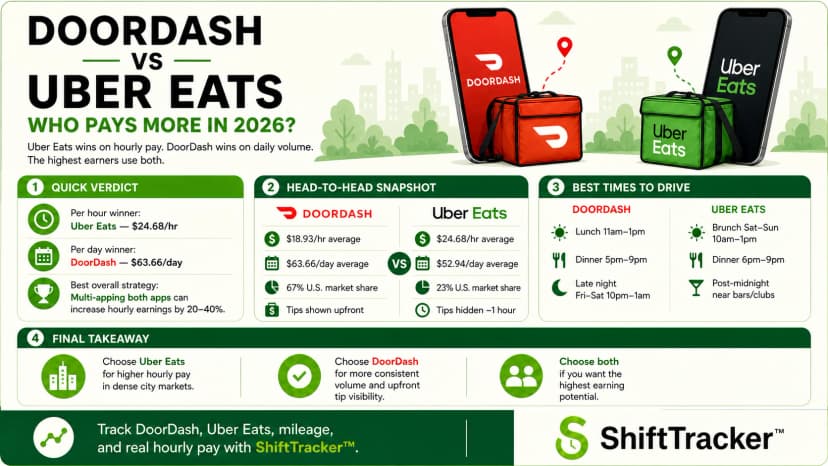
Uber Eats pays more per hour: $24.68/hr average vs DoorDash's $18.93/hr per Gridwise Analytics (2023 Q1 to 2024 Q2 data).
DoorDash pays more per day: $63.66/day vs Uber Eats' $52.94/day, thanks to 67% U.S. market share and higher order volume.
DoorDash shows tips upfront; Uber Eats hides tips for ~1 hour, making order selection harder on UE.
At the 2026 IRS rate ($0.76/mile from July 1, 2026; $0.725 for January–June), untracked mileage is costing you thousands at tax time.

See your real hourly rate after car costs.


Table of Contents
DoorDash vs Uber Eats in 2026: The Short Answer
Uber Eats pays more per hour ($24.68 vs $18.93), but DoorDash pays more per day ($63.66 vs $52.94). The reason: Uber Eats has longer, better-tipped orders in dense urban areas, while DoorDash's 67% U.S. market share means more pings and fewer dead zones, especially in suburban markets. The highest-earning drivers in 2026 run both apps simultaneously.
The hourly and daily pay figures in this guide come from Gridwise, which draws on earnings data from a network of more than 500,000 drivers and couriers. Its pay comparison table covers 2023 Q1 to 2024 Q2.
The Head-to-Head Pay Comparison
| Metric | DoorDash | Uber Eats |
|---|---|---|
| Average hourly earnings | $18.93/hr | $24.68/hr |
| Average daily earnings | $63.66/day | $52.94/day |
| U.S. market share | 67% | 23% |
| Tip transparency | Shown upfront | Hidden ~1 hour |
| Base pay per order | $2–$10+ | $2–$8+ |
| Peak surge multipliers | 1.25–1.5x | 1.5–2x |
The data shows a clear tradeoff: Uber Eats has higher per-hour earnings. DoorDash drivers earn more per day.
Why Uber Eats Pays More Per Hour
Uber Eats' higher hourly rate reflects order quality, not order volume. Typical UE orders are:
- Longer restaurant-to-residential routes vs DoorDash in many dense markets
- More surge-boosted during weekends and late nights, with 1.5–2x multipliers
In dense urban markets with strong restaurant partnerships (NYC, Seattle, San Francisco, Chicago), Uber Eats tends to pay more per hour than DoorDash.
Why DoorDash Pays More Per Day
DoorDash's higher daily earnings come from volume. With 67% of the U.S. delivery market versus Uber Eats' 23% (Statista via Deliverect, 2025), DoorDash's size can mean more orders to pick from in many non-urban markets. One thing that helps:
- Dash Now zones give real-time visual demand maps, letting you position into busy areas
In suburban, exurban, and small-city markets, DoorDash's volume advantage pushes daily earnings higher than Uber Eats even though per-hour rates are lower.
The Tip Transparency Difference (Huge for $/Mile Optimization)
DoorDash shows the full customer tip before you accept an order. Uber Eats obscures tips for roughly one hour after delivery to prevent cherry-picking. This operational difference matters more than most drivers realize:
- On DoorDash: You can calculate exact $/mile before accepting. Decline anything below your personal threshold (most top earners use $2/mile minimum).
- On Uber Eats: You're committing to an order without knowing the full payout. Drivers use the "$1/minute" rule as a baseline, but it's inherently noisier.
Drivers who optimize order selection aggressively — only accepting orders over a personal $/mile threshold — do significantly better on DoorDash because of this transparency.
Peak Time Strategy by Platform
Both platforms surge differently. Scheduling around each platform's peaks is how you maximize hourly rate:
DoorDash peak hours
- Lunch: 11am–1pm (strong in office-dense areas)
- Dinner: 5pm–9pm (the biggest window of the day)
- Late night: Fri–Sat 10pm–1am (bar close demand)
Uber Eats peak hours
- Brunch: Sat–Sun 10am–1pm (unique to UE, DoorDash is dead)
- Dinner: 6pm–9pm (strong surge pricing)
- Post-midnight: Near bars and clubs, 1.5–2x surge common
How Each Platform Calculates Your Pay
DoorDash Pay Formula
DoorDash sets base pay using estimated time, distance, and order desirability (how likely Dashers are to accept it). Base pay typically lands in the $2–$10+ range before tips. Layered on top:
- Peak Pay: $1–$4 bonus per order during high-demand windows, applied automatically.
- Challenges: Weekly $20–$100 bonuses for completing a set number of deliveries.
- Top Dasher: Drivers maintaining high acceptance and completion rates can Dash Now during off-peak hours without scheduling.
Uber Eats Pay Formula
Uber Eats calculates each delivery as base fare + per-mile rate + per-minute rate + promotions. Component ranges in 2026:
- Base fare: $1.50–$3.00 per pickup
- Per-mile rate: $0.50–$0.65/mile (varies by market)
- Per-minute rate: $0.12–$0.20/minute while on trip
- Surge: Dynamic multiplier (1.1x–3.0x+) shown as colored zones on the driver map
- Boost: Scheduled multipliers (1.25x–1.5x) during predictable busy windows
Two underrated Uber Eats surge windows worth scheduling around: rainy weather (demand can rise as drivers leave the road) and 2–3 hours before kickoff near stadiums on game days.
Multi-Apping: The Real Earnings Multiplier
The highest-earning delivery drivers in 2026 aren't loyal to one platform — they run both simultaneously. The strategy is simple:
- Log into both apps simultaneously on your phone
- Accept only the highest-value order available across both
- Use DoorDash as your primary volume app, Uber Eats for high-tip order cherry-picking
- Track total earnings and mileage by platform to measure true hourly rate
Running both apps gives you more orders to choose from, so you can skip the weak ones. For the full picture of how DoorDash and Uber Eats compare against the rest of the gig economy, see our top 10 highest-paying gig apps for 2026 ranked by real net hourly pay. If you would rather pre-book package routes than chase restaurant orders, see how much does Veho pay per route after car costs.
Expenses Change the Real Math
Gross pay is only part of the equation. The IRS standard mileage deduction is 2026 IRS mileage rate: $0.76 per mile from July 1, 2026 ($0.725 for January–June), which means every untracked business mile costs you money at tax time. A driver doing 20,000 business miles over 2026 (10,000 before July 1, 10,000 after) who tracks none of them leaves $14,850 in deductions on the table.
The platform that makes you drive more miles per dollar earned is quietly costing you more at tax time. Track mileage and platform earnings separately to calculate your real net hourly rate on each app. Use our mileage tax calculator to estimate your annual deduction.
The Verdict: Which Pays More?
There is no universal winner. The right answer depends on your city, the hours you drive, and how aggressively you filter orders. What the data clearly shows:
- Use Uber Eats if: You're in a dense urban market with strong restaurant partnerships and want higher per-order value. Focus on weekend brunch and dinner surges.
- Use DoorDash if: You're in a suburban or mid-size market, want consistent order flow, and prefer knowing tips upfront to filter by $/mile.
- Use both if: You want to maximize earnings. Multi-apping lets you pick the best order from either app.
Who Pays More in 2026: Uber Eats or DoorDash?
Uber Eats pays more per hour than DoorDash in 2026, averaging $24.68/hour gross compared to DoorDash's $18.93/hour per Gridwise's driver earnings data (2023 Q1 to 2024 Q2). That is a $5.75/hour gap - roughly $230 more per 40-hour week for Uber Eats drivers on paper.
But the story does not end at hourly rate. DoorDash delivers significantly more orders per hour in most markets because of its 67% US market share (versus Uber Eats at 23%). That means less downtime between orders and more consistent daily earnings. The real answer to "does Uber Eats or DoorDash pay more" depends on which metric matters to you:
- Per-hour pay: Uber Eats wins ($24.68 vs $18.93)
- Order volume: DoorDash wins by a wide margin
- Tip transparency: DoorDash wins (full tip shown upfront; Uber Eats hides tips for ~1 hour)
- Total weekly income potential: Tie - most top earners run both apps simultaneously
The drivers clearing $25+/hour consistently are not picking one app over the other. They are multi-apping DoorDash and Uber Eats, accepting only orders with pickup points within 0.5 miles, and cherry-picking the orders with tips shown upfront on DoorDash.
Want to run your own numbers? Our free Uber Eats earnings calculator shows your true hourly pay after gas, mileage, and the 2026 IRS standard mileage deduction.
Frequently Asked Questions
Does DoorDash or Uber Eats pay more in 2026?
Uber Eats pays more per hour — $24.68/hr vs DoorDash's $18.93/hr, per Gridwise Analytics data (2023 Q1 to 2024 Q2). DoorDash generates higher daily gross earnings ($63.66/day vs $52.94/day) due to its 67% U.S. market share and consistent order volume. The drivers earning the most run both apps simultaneously and only accept orders meeting their per-mile threshold.
Does Uber Eats pay more than DoorDash?
Per hour, yes — Uber Eats averages $24.68/hr vs DoorDash's $18.93/hr (Gridwise data, 2023 Q1 to 2024 Q2). Per day, DoorDash pays more ($63.66 vs $52.94) because of higher order volume from its 67% market share.
Why does DoorDash pay less per hour but more per day?
DoorDash dominates U.S. delivery market share (67% vs 23%), so drivers get more pings and spend less time waiting between orders. Uber Eats has higher per-order value and surge multipliers, but longer dead time in most markets.
Which app is better for new drivers?
DoorDash is better for beginners because tips are shown upfront, so you can evaluate each order before accepting. Uber Eats hides tips for ~1 hour, making it harder to filter bad orders when you're learning.
Can I run DoorDash and Uber Eats at the same time?
Yes. Both platforms allow multi-apping. Just pause one app when you accept an order on the other.
How much can I deduct for mileage on DoorDash or Uber Eats in 2026?
The 2026 IRS standard mileage rate is $0.725 per mile for January–June and $0.76 per mile from July 1. A driver logging 20,000 business miles over 2026, split evenly before and after July 1, can deduct $14,850 from their taxable income (10,000 × $0.725 + 10,000 × $0.76). Use the mileage tax calculator to estimate your deduction.
Founder of ShiftTracker. Lime LP for almost 4 years · 42,000+ tasks completed. Background in financial trading and behavioral optimization.
You Might Also Like
DoorDash Dasher Rewards and Driver Tiers Explained (2026)
Silver, Gold, Platinum — and what happened to Top Dasher. What each Dasher Rewards tier actually unl...
Can DoorDash Drivers See the Tip Before Accepting? (2026)
Dashers never see a line that says "tip: $8" — but the number on the offer screen already includes i...
Does DoorDash Take Out Taxes? 1099 Forms, Business Codes and What You Actually Owe
DoorDash withholds nothing from your pay: no federal tax, no Social Security, no Medicare. You owe 1...