Gig Economy Definition: What It Means for US Gig Workers

The Short Answer
About 64 million Americans freelanced in 2023, roughly 38% of the American workforce (Upwork), earning income through short-term contracts rather than traditional employment.
About 16% of Americans have ever earned money through an online gig platform (Pew Research, 2021).
Gig workers classified as independent contractors miss out on employer-provided health insurance, retirement contributions, and overtime protections that employees receive by law.
Self-employment tax hits gig workers at 15.3% on net earnings — compared to 7.65% for employees — because there's no employer to split the Social Security and Medicare contribution.
States like California, New York, and Illinois have passed or proposed minimum-pay and classification laws specifically targeting gig platforms, with more legislation expected through 2026.

See your real hourly rate after car costs.


Table of Contents
Nearly one in six Americans has earned money through a gig platform. That's not a niche statistic anymore. It's a structural shift in how the US economy works. But most people entering the gig economy discover, quickly, that the flexibility they signed up for comes packaged with a set of financial and legal realities nobody mentioned in the onboarding flow.
This piece gives you the real definition of the gig economy, how it actually functions for workers, and what the financial and legal picture looks like on the ground in 2026.
Gig Economy Definition: Short-Term Platform-Mediated Work, and 64 Million Americans Freelanced in 2023
The gig economy is a labor market where individuals earn income through short-term, task-based contracts (typically arranged through digital platforms) rather than traditional long-term employment. The World Economic Forum defines it as the exchange of labor for money through digital platforms that actively match providers and customers on a project-by-project basis.
In the US, that covers a massive slice of the workforce. About 64 million Americans performed freelance work in 2023, roughly 38% of the total workforce, according to the Upwork Freelance Forward study (2023). That covers all freelancing, not only app-based gig work.
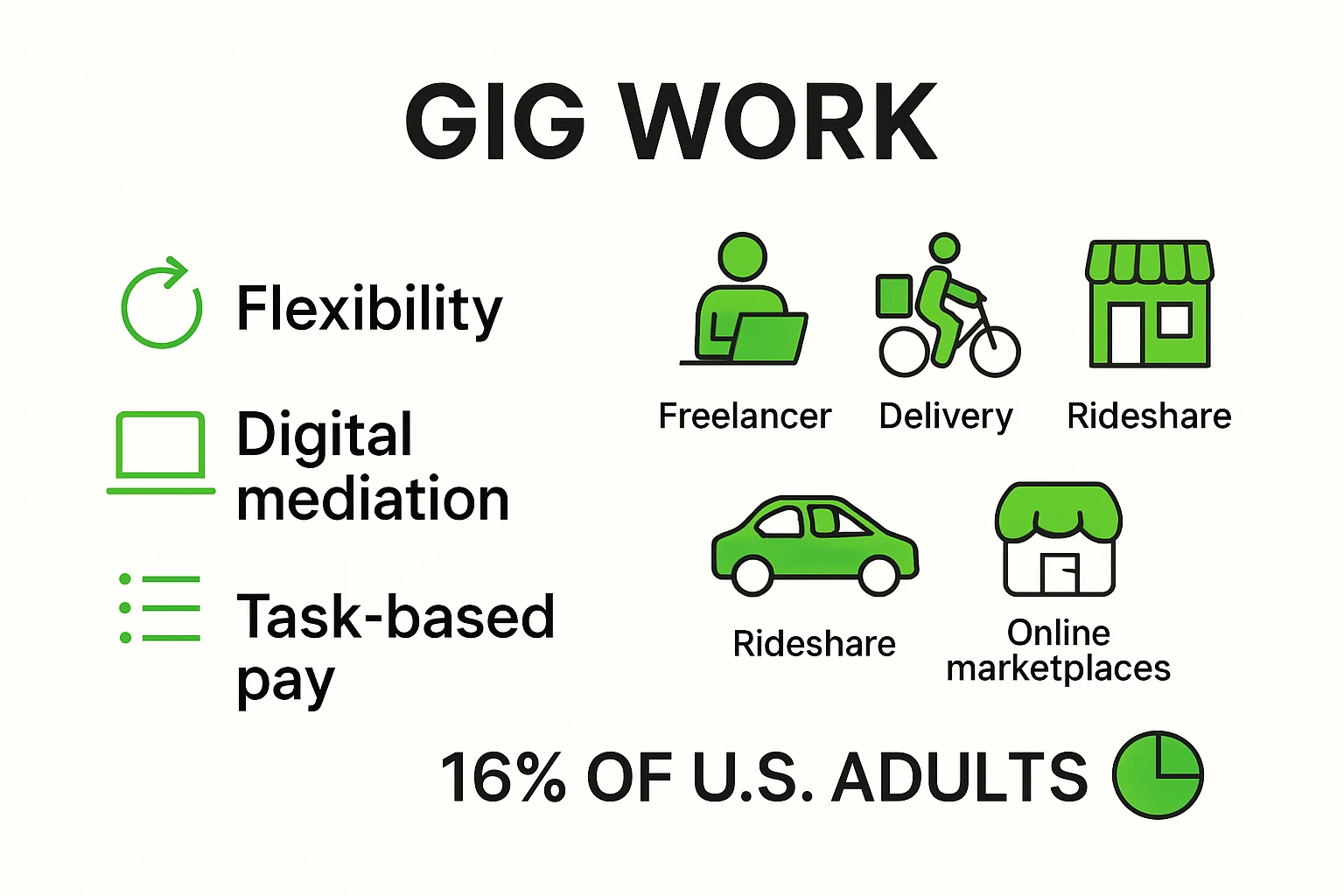
The defining characteristics of gig work:
- Flexibility: Workers control their own schedules and can accept or reject individual assignments.
- Digital mediation: A platform connects service providers with customers, handling matching, payment, and ratings.
- Task-based pay: Compensation is per completed job, not per hour or per salary period.
- Independent contractor status: Most gig workers are classified as independent contractors, not employees.
That last point is where the complications begin. Learn how gig worker financial literacy differs from traditional employment finance, and the gap is larger than most people expect.
Pew Research Center's 2021 survey found that 16% of Americans have ever earned money through an online gig platform. The survey counted ride-hailing, delivery, grocery shopping, household tasks and errands as gig platform work.
Source: Pew Research Center, "The State of Gig Work in 2021"
How the Gig Economy Works: Platforms, Ratings, and the Independent Contractor Gap
Platforms function as digital marketplaces. They handle customer acquisition, dispatch, payment processing, and reputation systems (ratings). Workers sign up, pass a background check, and start accepting jobs. The barrier to entry is genuinely low.
But low entry barriers come with a trade-off. Everything the platform handles for you comes out of your earnings. And everything the employer would normally handle (health insurance, retirement contributions, payroll tax, overtime) falls on you.

The practical mechanics:
- Algorithmic dispatch: The platform assigns or offers jobs based on ratings, location, and acceptance history. Your score directly affects how many opportunities you see.
- Rating systems: Customer ratings determine future job access on most platforms. Dropping below a threshold can restrict or suspend your account.
- Real-time bidding (some platforms): Freelance platforms like Upwork allow rate negotiation. Delivery and rideshare platforms set rates algorithmically.
- Income volatility: There is no guaranteed weekly income. Demand fluctuates by hour, day, season, and market conditions.
That income volatility is the most common shock for new gig workers. Traditional budgeting assumes predictable paychecks. Gig income requires a different approach entirely: one that starts with tracking your real hourly rate after expenses, not just your gross earnings. Understand the difference by reading about gross vs. net income for gig workers.
Pros and Cons: The Real Trade-Offs of Gig Work for US Workers
The flexibility is real. So are the costs. Here's an honest comparison:
| Factor | Advantage | Challenge |
|---|---|---|
| Schedule | Full control over hours | No guaranteed income floor |
| Entry | Low barriers, fast start | Must self-manage all business admin |
| Income | Multiple platform diversification | Variable week-to-week earnings |
| Benefits | N/A | No employer health, retirement, or PTO |
| Taxes | More deductions available | 15.3% self-employment tax, quarterly filing |
| Legal protections | N/A | Excluded from most wage and hour laws |
Workers who succeed long-term treat gig work like a business. They track which platforms pay best at which times, keep receipts for every deductible expense, and set aside 25–30% of gross earnings for taxes and savings before spending anything. That discipline is what separates sustainable gig income from a financial spiral.
Self-employed gig workers pay the full 15.3% self-employment tax on net earnings (12.4% for Social Security and 2.9% for Medicare), compared to the 7.65% an employee pays, because an employer covers the other half. This effectively means a gig worker earning $50,000 net owes roughly $3,500 more in tax annually than a salaried employee at the same income level.
Source: IRS, Topic No. 554, Self-employment tax and Topic No. 751, Social Security and Medicare withholding rates
Legal Rights and Worker Classification: What the Law Does and Doesn't Cover
Worker classification is the defining legal issue in the gig economy. Most gig workers are classified as independent contractors, which places them outside the protections of the National Labor Relations Act, the Fair Labor Standards Act's minimum wage and overtime provisions, and most employer-provided benefit requirements.
That classification is actively contested. California's AB5 reclassified many gig workers as employees before Proposition 22 carved out an exemption for app-based transportation and delivery workers with new minimum-pay standards. New York City passed a minimum pay floor for delivery workers in 2023. Illinois and other states have proposed similar measures.
Key legal challenges facing gig workers today:
- Classification disputes: Independent contractor vs. employee status determines access to benefits and legal protections.
- State-level variation: Rights differ significantly by state: what applies in California doesn't apply in Texas.
- Tax obligations: Quarterly estimated tax payments, Schedule C filing, and self-employment tax are all the worker's responsibility.
- Limited dispute resolution: Platform ToS typically requires arbitration, limiting workers' legal remedies.
Understanding these dynamics is part of operating smartly as a gig worker. Read the complete gig worker tax guide to understand the deductions that partially offset the self-employment tax burden.
The Bureau of Labor Statistics estimates there were 11.9 million independent contractors in the US in July 2023, 7.4 percent of total employment, a category that includes many gig platform workers. Unlike employees, these workers generally do not qualify for regular state unemployment insurance, so an app deactivation or slow season has no safety net backstop.
Source: U.S. Bureau of Labor Statistics, Contingent and Alternative Employment Arrangements Survey, July 2023
Financial Strategies That Actually Work for Gig Workers
The workers who build stable income in the gig economy share a few consistent habits:
- Diversify across platforms. Two to three platforms gives you more pricing power and a fallback if one lowers rates or deactivates your account.
- Track net hourly rate, not gross earnings. After fuel, vehicle wear, and time between jobs, your real hourly rate is often well below the gross per-trip number.
- Set a tax reserve automatically. Move 25–30% of every deposit to a separate account before touching it. Quarterly tax bills are non-negotiable.
- Document every business expense. Mileage, phone, equipment, data plans. These reduce your taxable income and are fully legal deductions for independent contractors.
- Build a 3-month income buffer. Slow periods happen. Platform algorithm changes happen. A buffer prevents desperate decision-making when earnings drop.
ShiftTracker's earnings dashboard helps gig workers track net hourly rate across platforms automatically, which is the number that actually tells you whether a shift was worth taking. See how gig analytics tools turn raw shift data into actionable income strategy.
Frequently Asked Questions
What is the gig economy?
The gig economy is a labor market where workers earn income through short-term, platform-mediated contracts rather than traditional employment. About 64 million Americans freelanced in 2023 (roughly 38% of the workforce, per Upwork), making it a mainstream employment category rather than a fringe alternative.
How does independent contractor status affect taxes?
Independent contractors pay 15.3% self-employment tax on net earnings, covering both halves of Social Security and Medicare. They also file quarterly estimated taxes and Schedule C. The upside is access to business deductions for mileage, equipment, and home office that employees don't get.
What legal protections apply to US gig workers?
Federally, independent contractors are excluded from most wage and hour laws. State laws vary significantly: California and New York have enacted gig-specific minimum pay floors. New legislation is advancing in multiple states through 2026, so knowing your state's current rules matters.
How do successful gig workers manage income volatility?
The most consistent tactic: work multiple platforms, track net hourly rate per platform, set a fixed 25–30% savings rule for taxes and emergency fund, and build peak-hour schedules based on personal earnings data rather than guessing. Tracking tools that show real hourly rate after expenses are the foundation.
Founder of ShiftTracker. Lime LP for almost 4 years · 42,000+ tasks completed. Background in financial trading and behavioral optimization.