10 Highest-Paying Gig Apps in 2026 (Best for Same-Day Pay & Always-Hiring Platforms)
TL;DR
- Medical courier apps rank #1 at $24-$32/hr net (limited availability)
- Walmart Spark is #2 at $22-$32/hr typical, $30-$40+ for top Tier 2 drivers in suburbs
- Amazon Flex is #3 at $22-$28/hr with predictable block pay
- Instacart suburban shoppers earn $20-$26/hr on weekends
- DoorDash and Uber Eats stacked together pay $22-$28/hr during peaks; TaskRabbit has the highest ceiling ($45+/hr)
Table of Contents
Free Download: 2026 Gig Worker Tax Survival Kit
Complete deduction checklist, IRS mileage guide, and quarterly tax calendar for 11 platforms.
The 10 Highest-Paying Gig Apps in 2026: The Short Answer
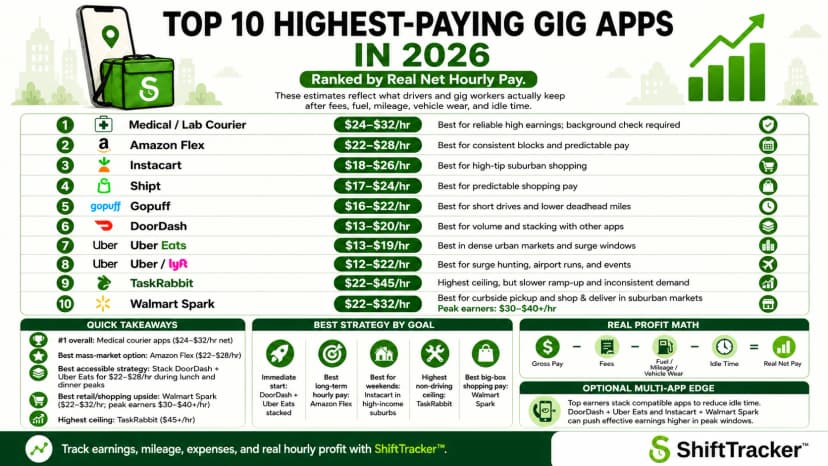
Medical courier apps (Dropoff, Roadie Medical) top the 2026 list at $24-$32/hour net, followed by Walmart Spark ($22-$32/hr typical, $30-$40+ for peak earners) and Amazon Flex ($22-$28/hr). The popular food delivery apps most drivers default to - DoorDash and Uber Eats - rank 7th and 8th for solo drivers at $13-$20/hr. But stacking them together pushes effective pay to $22-$28/hr during lunch and dinner peaks, matching the top-ranked apps without the access barriers.
These rankings measure net hourly pay: what you actually keep after platform fees (15-30%), fuel, vehicle depreciation, and idle time between orders. Platform marketing focuses on gross pay; drivers get paid on net. The gap between those two numbers is typically $8-$15 per hour.
How Did We Rank the Top 10 Gig Apps?
Earnings data combines driver survey aggregates from gig economy forums (r/UberDrivers, r/doordash_drivers, r/InstacartShoppers, r/Sparkdriver), published platform earnings claims, our own analysis of Walmart Spark driver pay across 2026 markets, and independent researcher estimates including Gridwise's 2026 driver pay report. "Net hourly" reflects approximate earnings after platform fees and estimated vehicle costs at the IRS 2026 standard rate of 2026 IRS mileage rate of $0.725 per mile, averaged across market sizes and experience levels. Your results will vary by city, vehicle, time of day, and acceptance strategy - so track your own numbers to find your personal peak.
The 2026 Gig App Earnings Rankings
| Rank | Platform | Work Type | Est. Net Hourly | Best For |
|---|---|---|---|---|
| 1 | Medical / Lab Courier | On-demand medical delivery | $24-$32/hr | Reliable high earners; requires background check |
| 2 | Walmart Spark | Walmart grocery + retail delivery | $22-$32/hr | Suburban Tier 2 drivers; peak earners hit $30-$40+/hr |
| 3 | Amazon Flex | Package delivery blocks | $22-$28/hr | Consistent blocks; lower mileage than food delivery |
| 4 | Instacart Shopper | Grocery shopping + delivery | $18-$26/hr | High-tip potential; works best in high-income areas |
| 5 | Shipt | Grocery / retail shopping | $17-$24/hr | Consistent pay; Target preferred shopper perks |
| 6 | Gopuff | Convenience delivery | $16-$22/hr | Short drives; hub-based reduces deadhead miles |
| 7 | DoorDash | Food + retail delivery | $13-$20/hr | High order volume; strong stacking partner |
| 8 | Uber Eats | Food delivery | $13-$19/hr | Best in dense urban markets; Quest bonuses help |
| 9 | Uber / Lyft (Rideshare) | Passenger transport | $12-$22/hr | High ceiling in surge; lowest average after deadhead |
| 10 | TaskRabbit | Handyman / labor tasks | $22-$45/hr | Highest ceiling; slow ramp-up; most inconsistent |
Platform Deep Dives
1. Medical Courier Apps (Dropoff, Roadie Medical)
Medical and lab specimen courier services pay $24-$32/hr net because deliveries are time-sensitive (hospitals and labs cannot wait), routes are typically shorter than food delivery, and the pool of drivers willing to handle medical materials is small. Background checks, valid driver's license, and a reliable vehicle are required. Apps include Dropoff, Roadie (medical), and regional courier networks. The drawback: fewer available gigs than food delivery; earnings depend heavily on proximity to hospitals and labs.
2. Walmart Spark
Walmart Spark earned the #2 spot for 2026 because experienced drivers in suburban markets consistently report $22-$28/hr net during weekday peak windows, with Saturday-only side hustlers regularly clearing $25-$32/hr and top performers (Tier 2 status, batch mastery, optimized zones) hitting $28-$35+/hr. During holiday season weekday lunches, peak earners report $30-$40/hr in dense suburban Walmart markets. The platform's structural advantage over food delivery: customers tip more on grocery orders ($80+ average cart vs $40 for restaurants), Walmart's footprint covers 4,700+ stores, and Spark drivers are not stuck waiting on slow restaurant prep times.
Spark pay has three components: base pay per delivery ($7-$14 based on distance and complexity), customer tips ($3-$8 per order on average), and Peak Pay bonuses ($2-$8 per order during high-demand windows). Driver type matters more here than on most platforms - see our full honest answer on whether Spark is worth it in 2026 for the breakdown by driver profile.
The platform's secret weapon is Tier 2 status and the new Silver/Gold/Sapphire pilot: hit 20 trips with a Green Customer Rating in a calendar month and you unlock priority on high-paying Express orders, early scheduling access, and a free Walmart+ membership ($98/year value) that includes free grocery delivery, free shipping, and gas discounts. Drivers who shop at Walmart anyway get $98 of effective additional comp on top of hourly earnings.
Honest caveat: Spark is best in suburban markets with 100k-500k populations and not great in dense urban cores. Drivers in NYC, LA core, and SF report net pay dropping to $12-$16/hr because parking costs, traffic, and lower per-order tips erode margins. The full Spark 2026 driver economics are detailed in our Walmart Spark Driver Pay 2026 breakdown.
3. Amazon Flex
Amazon Flex pays $18-$25/hr gross for 2-5 hour delivery blocks, working out to roughly $22-$28/hr net because block pay is predictable and routes are optimized by Amazon's logistics system (reducing wasted miles). Blocks are claimed via the app and fill quickly - drivers in high-demand markets use auto-refreshing tools (within Amazon's terms) to capture blocks. Key limitation: schedule availability is not guaranteed; income is lumpy between block windows.
4. Instacart Shopper
In-store shoppers who learn efficient shopping routes, maintain 5-star ratings, and work premium shopping hours (Friday-Sunday) consistently hit $20-$26/hr net. Tips - which can run $5-$20 per order - are the difference between median and top-tier pay. Primary expense is personal time in-store rather than vehicle costs (full-service shoppers incur both). Markets like suburban Chicago, Dallas, and Phoenix consistently report higher batch pay than dense urban markets where parking costs erode margins.
5. Shipt
Shipt operates similarly to Instacart but with tighter integration into Target's ecosystem. Shoppers who qualify as "Shipt Preferred" get priority on high-paying orders and better weekly availability. Net hourly pay of $17-$24/hr reflects lower order volume than Instacart in most markets, but Shipt's flat-rate per-order pay structure makes earnings more predictable. Best strategy: run Shipt and Instacart simultaneously in shopping centers that host both Target and a major grocery store.
6. Gopuff
Gopuff's hub-based model is the major advantage - drivers return to a central warehouse between deliveries instead of chasing restaurants across town. That structurally eliminates deadhead miles, which is the #1 profit killer in food delivery. Net pay of $16-$22/hr reflects lower tips than full-service delivery, offset by much lower vehicle wear. Best for drivers in markets where Gopuff has strong hub coverage (Philadelphia, Austin, Denver, Boston).
7-8. DoorDash and Uber Eats
Both platforms anchor the delivery gig economy. DoorDash held approximately 67% of the U.S. food delivery market in 2025; Uber Eats held 23%. Net earnings for median drivers fall in the $13-$20/hr range after fuel, primarily because food delivery involves significant idle time between orders and deadhead miles to restaurant pickup. Top earners use multi-apping - running DoorDash and Uber Eats simultaneously - to eliminate idle gaps and push effective hourly rates to $22-$28/hr during lunch and dinner peaks. See our DoorDash vs Uber Eats breakdown for a head-to-head comparison.
9. Rideshare (Uber / Lyft)
Rideshare has the widest pay variance of any gig platform. During surge pricing, an experienced driver in a major city can clear $28-$35/hr. During off-peak hours, accounting for deadhead miles to pickup locations, the same driver may net $10-$14/hr. The average conceals this variance. Rideshare works best as a surge-hunting strategy: working Friday and Saturday nights (10pm-3am), airport queues, and major events - rather than as a consistent daily grind.
10. TaskRabbit
TaskRabbit is an outlier: the highest ceiling ($45+/hr for skilled labor like furniture assembly or TV mounting) but the slowest ramp-up time. New Taskers typically spend 2-4 weeks building reviews before orders flow consistently. Once established with 50+ five-star reviews, skilled Taskers in major metros regularly report $30-$40/hr for weekend work. The platform charges a service fee to clients (not Taskers), meaning your set rate is your take-home (minus taxes).
Should You Multi-App to Earn More?
Single-platform drivers leave significant money on the table. Multi-apping - running two or more compatible delivery apps simultaneously - increases order density without proportionally increasing mileage. The most effective pairings in 2026:
- DoorDash + Uber Eats: Largest order pools; accept a second order only when pickup locations overlap within 0.5 miles.
- Walmart Spark + Instacart: Both pull from grocery delivery demand; run simultaneously when your nearest Walmart and a major grocery chain are within the same shopping zone. See our Walmart Spark vs Instacart head-to-head comparison for which to prioritize.
- Instacart + Shipt: Both require in-store shopping; accept the second order only when stores are in the same shopping center.
- Amazon Flex + DoorDash: Work Amazon blocks primarily; fill gaps between Amazon deliveries with DoorDash when blocks end early.
Experienced multi-appers report pushing effective hourly earnings to $22-$28/hr during lunch and dinner peaks - well above the single-platform median.
How Do You Track Your Real Net Earnings?
The only way to know your real hourly rate is to track time in plus time out, all miles driven (not just paid miles), and every dollar earned across platforms. Most drivers underestimate mileage and overestimate their hourly rate by 20-30% when relying on memory. ShiftTracker automatically logs mileage and consolidates earnings across platforms so you can see your true net per hour on any given shift.
Which Gig Apps Should You Prioritize in 2026?
Based on net earnings potential and access barriers:
- Best blend of pay and availability: Walmart Spark in suburban Tier 2 status (peak earners $30-$40+/hr)
- Immediate start, consistent volume: DoorDash + Uber Eats stacked
- Best long-term earnings per hour: Amazon Flex (requires patience for block access)
- Highest ceiling: TaskRabbit (requires skill and patience for reviews)
- Easiest $20+/hr for experienced shoppers: Instacart in high-income suburbs
Frequently Asked Questions
What is the highest-paying gig app in 2026?
Medical courier apps like Dropoff and Roadie Medical pay the highest net hourly rate in 2026 at $24-$32/hr, driven by time-sensitive deliveries, shorter routes, and a smaller driver pool due to background check requirements. Walmart Spark ranks #2 at $22-$32/hr typical, with peak earners (Tier 2 status, suburban markets, Saturday windows) regularly hitting $30-$40+/hr.
Is Walmart Spark in the top 10 highest-paying gig apps for 2026?
Yes - Walmart Spark ranks #2 on our 2026 list at $22-$32/hr typical net pay, behind only medical courier apps. Spark beats Amazon Flex, Instacart, and DoorDash by ceiling because top-performing Tier 2 drivers in suburban markets regularly clear $30-$40/hr during weekday peak lunch windows and Saturday peaks. The platform's free Walmart+ membership benefit ($98/year) for Tier 2 drivers adds effective compensation that other gig apps do not match.
How much do top Walmart Spark drivers make per hour in 2026?
Top Walmart Spark drivers earn $28-$35+/hr through batch mastery, prime zone positioning, and incentive stacking. Saturday peak specialists in suburban markets clear $25-$32/hr in a single shift. During the holiday season weekday lunch windows, peak earners report $30-$40/hr. See our Walmart Spark pay guide for the full breakdown by driver type, market, and time slot.
Can you make $25 an hour on gig apps?
Yes, but only on certain platforms and during specific windows. Medical courier apps, Walmart Spark (Tier 2 in suburbs), and Amazon Flex consistently pay above $25/hr for qualified drivers. Instacart shoppers in high-tip suburbs hit $25+/hr on weekends. DoorDash and Uber Eats drivers crack $25/hr only by multi-apping during lunch and dinner peaks in busy markets.
Which gig app pays more: DoorDash or Uber Eats?
Uber Eats pays slightly more per hour on average ($13-$19/hr net vs DoorDash's $13-$20/hr), but DoorDash offers significantly higher order volume in most US markets due to its 67% market share. Top-earning drivers run both simultaneously - see our full DoorDash vs Uber Eats comparison.
Is Amazon Flex better than DoorDash?
For net hourly pay, yes - Amazon Flex averages $22-$28/hr vs DoorDash's $13-$20/hr. But Flex requires claiming blocks that fill quickly and offers no on-demand flexibility. DoorDash wins on scheduling freedom; Flex wins on hourly rate when you can get blocks.
What gig app pays the most without driving long distances?
Walmart Spark and Gopuff both rank high on short-distance efficiency. Spark drivers stay within their assigned drop zone (typically a 5-10 mile radius from the Walmart store), and Gopuff operates from a central hub so deadhead miles are nearly zero. For local non-driving gig work, TaskRabbit handyman services in major metros regularly earn $30-$45/hr once established.
How much can a full-time gig worker make in 2026?
A full-time gig worker running optimized multi-apping strategies 40 hours/week can realistically earn $800-$1,200/week net ($42,000-$62,000/year) in most US markets. Top performers in high-income metros using premium platforms (medical courier, Walmart Spark Tier 2, Amazon Flex, Instacart) regularly clear $1,400+/week.
Founder of ShiftTracker. 5+ years active gig work experience with 35,000+ completed tasks across Uber, DoorDash, Instacart, and Lime. Background in financial trading and behavioral optimization.
You Might Also Like
Best Shift Tracking Apps for Gig Workers in 2026
Compare the best shift tracking apps for gig workers in 2026. See which tools offer automatic tracki...
12 Best Gig Worker Apps Always Hiring in 2026 (Same-Day Pay + Real Earnings Ranked)
See the best gig worker apps for 2026 — automate mileage, track expenses, use earnings analytics, an...
Maximize Gig Income & Savings With Smarter Expense Tracking
Learn how automated mileage tracking, receipt capture, real-time analytics, and AI tools help gig wo...
Track your shifts smarter
Join 1,000+ gig workers using ShiftTracker to optimize earnings and simplify taxes.
Download the App