Free calculator · any gig app
Profit Per Mile Calculator
What a shift paid, minus what your car cost to drive it. Per mile and per hour.
By Brenden Warn, Founder & Gig Economy Analyst
Last updated
Where the 53 cents comes from
It's my own 2016 Ford Escape. When I first ran the car through ShiftTracker in September, I expected 30 to 35 cents a mile. It came back at 49, and by October 17 it was 53.
Your car will be different, so change it. That one input moves the answer more than any other.
Profit per mile
The numbers above are an example shift, not an average. Swap in one of your own.
Mileage deduction: $53.20 at 76 cents a mile (from July 1, 2026; 72.5 cents for January-June, IRS). It isn't money out of your pocket; it lowers your taxable profit, and the tax line above already uses it. Self-employment tax is 15.3% of 92.35% of that profit (IRS Topic 554). Income tax isn't included.
*53 cents a mile is ShiftTracker's estimate for my 2016 Ford Escape on October 17, 2026: fuel, insurance, maintenance, depreciation and loan interest. It's approximate and depends on your vehicle, fuel prices and location, so enter your own.
Track this for every shift in ShiftTracker.


The Short Answer
- Profit per mile is what a shift paid, minus your car's cost and the tax you set aside, divided by every mile you drove.
- Count miles from the start of the shift to the end, off the odometer. The drive to the first pickup and back from the last drop-off cost the same per mile as the paid ones.
- The IRS mileage rate (76 cents from July 1, 2026) is a deduction, not your cost. Use your own car's number if you have it.
How profit per mile is calculated
Three subtractions and one division. Start with what the shift paid: base pay, tips and any bonus, all together. Take off the car cost, which is the miles you drove times what your car costs per mile. Take off the self-employment tax you'll owe on it. Divide what's left by the miles.
The example in the calculator is a $120.00 shift over 70 miles and 5 hours. At 53 cents a mile the car took $37.10. Self-employment tax to set aside is $9.44. That leaves $73.46, which is $1.05 a mile and $14.69 an hour. The app's own summary for that shift would have said $24.00 an hour.
Why the small offer can win
Run two made-up offers at 53 cents a mile. An $18 batch that covers 22 miles costs $11.66 to drive, so it leaves $6.34 before tax. A $9 order over 4 miles costs $2.12 and leaves $6.88. The bigger offer pays twice as much and keeps less, and it ties up the car for 18 more miles.
Per mile, that's 29 cents kept against $1.72. A cost per mile that's higher or lower than mine moves both numbers, but it moves the long offer more.
What goes into car cost per mile
Fuel is the part you see at the pump. The rest shows up later: insurance, oil and tires, repairs, the value the car loses with every mile, and interest if there's a loan on it. Add a year of those and divide by the miles you drove that year.
If you don't have a year of records, the IRS standard mileage rate works as a stand-in: 72.5 cents a mile for January through June 2026 and 76 cents from July 1. It's the amount you deduct per business mile, and it's the number to use at tax time whatever your real cost is. If you want the method that uses your actual receipts, see standard mileage vs actual expenses.
Either way you need the miles, and the IRS wants them written down when they happen. How to track mileage for taxes covers what a log has to show.
Calculators for one app
Same math, with each app's own pay terms and a sample order from that app.
Profit per mile FAQs
How do I calculate profit per mile?
Take what the shift paid, subtract your car's cost (miles driven times your cost per mile) and the self-employment tax you need to set aside, then divide what's left by the miles. Use every mile from the start of the shift to the end, read off the odometer, not only the miles the app paid you for.
What should I enter for car cost per mile?
Your own number if you have it: a year of fuel, insurance, maintenance, depreciation and loan interest, divided by the miles you drove. If you don't have it yet, the IRS standard mileage rate (76 cents a mile from July 1, 2026; 72.5 cents for January-June) is a stand-in. The IRS bases it on a yearly study of what it costs to run a car.
Is the IRS mileage rate the same as what my car costs me?
No. The IRS rate is a tax deduction: it lowers the profit you're taxed on. Your car's cost per mile is cash that leaves your pocket. They can be far apart. My 2016 Ford Escape came out at 53 cents a mile on October 17, 2026, against the 76-cent IRS rate.
Does this profit per mile include taxes?
It sets aside self-employment tax, which is 15.3% of 92.35% of your profit after the mileage deduction (IRS Topic 554). Federal and state income tax depend on the rest of your return, so they aren't included.
Track this for every shift in ShiftTracker
Enter your odometer at the start and end of a shift, and what it paid. ShiftTracker works out the profit per mile and per hour with your own car's cost.
Related from the Blog
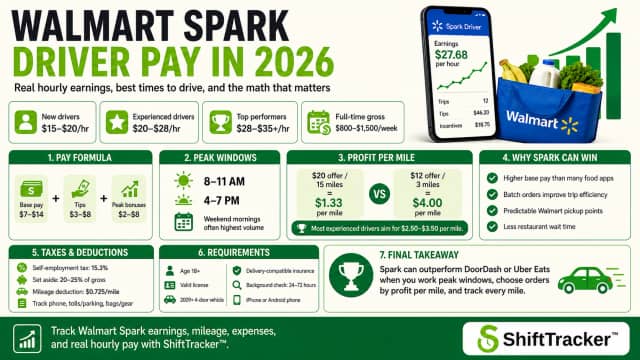
How Much Do Walmart Spark Drivers Make in 2026? Real Pay Per Delivery + Per Hour
Walmart Spark drivers earn $15-$30 per hour in 2026, before expenses. Here's the pay breakdown — what you'll actually take home after gas, mileage, and taxes.
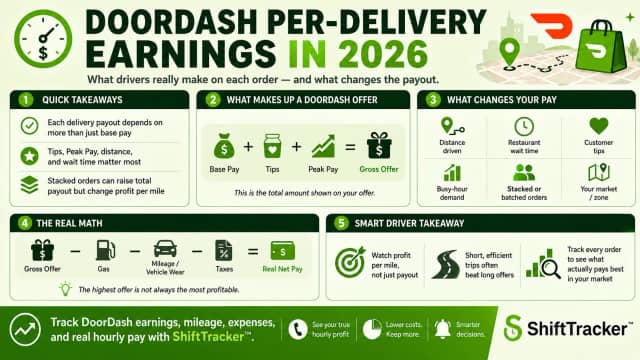
DoorDash Per Delivery Earnings Guide (2026)
How much does DoorDash pay per delivery in 2026? Base pay is $2-$10+, and with tips most Dashers average roughly $5-$8 per order. This guide breaks down the real per-delivery math - base pay, tips, and Peak Pay - what changes it, and why gross per delivery is not what you take home after gas and mileage.

Best Mileage Tracker Apps for Gig Workers (2026)
Compare the best mileage tracker apps for gig workers to maximize tax deductions, simplify IRS compliance, and increase net earnings.
