DoorDash Per Delivery Earnings Guide (2026)
The Short Answer
- DoorDash pay per delivery = Base Pay + Promotions + Tips. Base pay runs $2 to $10+ per order, set by time, distance, and desirability (DoorDash).
- With tips, most deliveries land around $5–$8 in a typical market — from ~$3 (short, no tip) to $15+ (long distance + good tip + Peak Pay).
- 100% of tips go to you, and Peak Pay adds a flat bonus per delivery during busy windows.
- Gross per delivery isn’t take-home. Gas and vehicle wear come out — the 2026 IRS mileage rate of $0.76/mile (July 1, 2026 onward) is your biggest offset.
- The number that matters is $/mile and $/hour, not $/delivery. A $7 order that costs 8 miles can pay less than a $4 order that costs 1 mile.
Table of Contents
Free Download: 2026 Gig Worker Tax Survival Kit
Complete deduction checklist, IRS mileage guide, and quarterly tax calendar for 11 platforms.
DoorDash base pay is $2 to $10 or more per delivery, and once you add tips, most deliveries land somewhere around $5–$8 in a typical market — with a real range from about $3 for a short no-tip order to $15+ for a long delivery with a good tip during Peak Pay. But "per delivery" is the wrong number to optimize, and I'll show you why below.
I've run 35,000+ tasks across DoorDash, Uber Eats, Lime, and Lyft over 5+ years, and built ShiftTracker after watching too many new Dashers chase the wrong metric. The pay-model facts here come straight from DoorDash's own Dasher pay pages; the realistic dollar ranges are from my own driving and what holds up across markets. Where I'm giving an estimate rather than an official figure, I'll say so.
How DoorDash pay per delivery is calculated
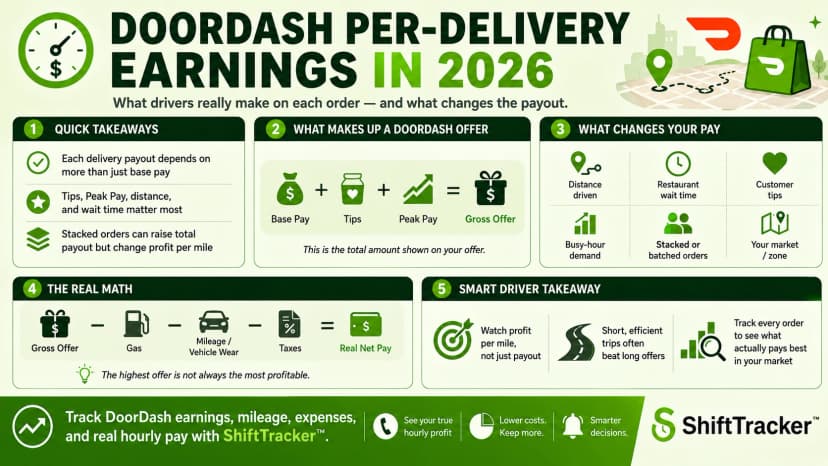
Every DoorDash offer is built from three parts (DoorDash):
- Base Pay — DoorDash's guaranteed amount for the delivery, typically $2 to $10+. It's higher for orders that take more time, cover more distance, or are less popular with Dashers (so a far-away or awkward order pays more base to get someone to take it).
- Promotions — mostly Peak Pay, a flat bonus added to each delivery during busy windows (often $1–$4/delivery, sometimes more). Challenges (e.g. "complete 20 deliveries, earn $X extra") also fall here.
- Tips — 100% of the customer's tip goes to you, on top of base and promotions. Tips are the single biggest swing factor in per-delivery pay.
So a single delivery might be $2.50 base + $2 Peak Pay + $5 tip = $9.50. Or it might be $3 base + $0 tip = $3. The base is the floor; tips and promotions are what move the number.
How much is that per delivery, really?
Here's a realistic per-delivery breakdown for a typical suburban market. Treat these as directional — your market, time of day, and order mix shift them:
| Order type | Base | Tip | Peak Pay | Total |
|---|---|---|---|---|
| Short, no tip (worst case) | $2–$3 | $0 | $0 | ~$2.50 |
| Typical lunch/dinner order | $2–$4 | $3–$5 | $0–$2 | ~$6–$8 |
| Long-distance, good tip | $5–$8 | $6–$10 | $0–$3 | ~$12–$18 |
| Stacked (2 orders at once) | $4–$7 | $5–$9 | $0–$4 | ~$10–$18 |
Across a full shift, those average out to roughly $5–$8 per delivery for most drivers, and DoorDash markets an average of around $23 per active hour — but "active" only counts time from accepting to dropping off, not the waiting and driving between orders. Real gross is usually $15–$22/hour before expenses. For the hourly picture, see our DoorDash earnings hub.
What changes your per-delivery pay
Five levers move the number, in roughly this order of impact:
- Tips — the biggest variable. Higher-income zones, larger orders, and good service all push tips up. No-tip orders are where the "$3 delivery" comes from.
- Distance & time — longer/slower orders carry more base pay, but they also burn more miles and minutes, so a high base doesn't always mean high profit (more on that next).
- Peak Pay — working dinner (5–9 PM) and weekend rushes adds a flat per-delivery bonus. See the best times to DoorDash for when Peak Pay fires most reliably.
- Market — dense urban and high-income suburban markets pay more per delivery than rural ones.
- Order desirability — DoorDash pads base pay on orders other Dashers keep declining, so unpopular orders sometimes hide real value.
The catch: gross per delivery isn't take-home
This is the part the forums and the official pages skip, and it's the whole game. The dollars DoorDash shows you per delivery are gross — gas, maintenance, and vehicle depreciation come out of that before it's really yours. A $7 order that costs you 8 miles of driving can net less than a $4 order that costs 1 mile.
The good news is the offset. The 2026 IRS standard mileage rate is $0.76 (July 1, 2026 onward) per business mile (IRS Publication 463), which you deduct on Schedule C. Every business mile you drive shaves $0.76 (July 1, 2026 onward) off your taxable income — so a Dasher logging 15,000 business miles captures a $11,400 deduction. The catch: you have to track those miles. Log your odometer at the start and end of each shift — the audit-defensible format Publication 463 asks for — and you keep the full deduction instead of guessing in April. See the real cost picture in our hidden expenses of DoorDash guide and the DoorDash mileage deduction guide.
How to raise your real per-delivery earnings
Stop optimizing $/delivery and start optimizing $/mile and $/hour. The habits that move it:
- Judge offers by dollars-per-mile. A quick rule: aim for $2/mile or better. A $6 order over 2 miles ($3/mile) beats a $9 order over 6 miles ($1.50/mile), even though the second looks bigger.
- Decline low base + no visible tip on long distances. Those are the orders that quietly lose you money.
- Work Peak Pay windows. The same delivery pays $2–$4 more during a dinner or weekend rush.
- Multi-app to cut dead time. Running a second app fills the gaps between DoorDash offers — see our multi-app strategy guide.
- Know your true rate. Estimate net pay after gas and the mileage deduction with the DoorDash earnings calculator.
Frequently asked questions
How much does DoorDash pay per delivery in 2026?
DoorDash base pay is typically $2 to $10+ per delivery, set by the order's time, distance, and desirability. Adding tips (100% of which go to the Dasher) and any Peak Pay, most deliveries land around $5–$8 in a typical market — ranging from about $3 for a short no-tip order to $15+ for a long, well-tipped delivery during Peak Pay.
What is DoorDash's minimum pay per delivery?
Base pay starts around $2 per delivery, so the practical minimum for a short no-tip order is roughly $2–$3. There's no fixed floor beyond base pay, but DoorDash adds more base pay to longer or less-popular orders. In Earn by Time mode, you're instead paid a guaranteed per-active-hour rate that varies by market.
Do DoorDash tips come on top of base pay?
Yes. Tips are paid in full to the Dasher on top of base pay and any promotions — DoorDash does not use tips to cover base pay. A delivery's total is base pay + promotions (like Peak Pay) + the customer's tip.
Is $5 per delivery good for DoorDash?
It's about average. Around $5–$8 per delivery is typical, but the better question is dollars-per-mile: $5 on a 1-mile delivery is excellent ($5/mile), while $5 on a 5-mile delivery is weak ($1/mile) once you account for gas and vehicle wear. Aim for $2/mile or better.
How do I keep more of my per-delivery pay?
Two levers: take higher dollars-per-mile orders (decline low base + no-tip long-distance offers), and capture the 2026 IRS mileage deduction of $0.76 (July 1, 2026 onward) per business mile by keeping an odometer-based mileage log. The deduction directly reduces the income you pay self-employment and income tax on, so tracking miles is effectively a raise at tax time.
Bottom line
DoorDash pays $2–$10+ in base pay per delivery, and with tips and Peak Pay most orders land around $5–$8 — but that gross number isn't what you keep. The drivers who actually do well ignore the per-delivery figure and chase dollars-per-mile and true hourly rate after expenses, then capture the full 2026 mileage deduction at $0.76/mile (July 1, 2026 onward). Track every mile and every order from day one, and you'll know which deliveries are actually worth taking.
Founder of ShiftTracker. 5+ years active gig work experience with 35,000+ completed tasks across Uber, DoorDash, Instacart, and Lime. Background in financial trading and behavioral optimization.
You Might Also Like
DoorDash Dasher Rewards and Driver Tiers Explained (2026)
Silver, Gold, Platinum — and what happened to Top Dasher. What each Dasher Rewards tier actually unl...
Can DoorDash Drivers See the Tip Before Accepting? (2026)
Dashers never see a line that says "tip: $8" — but the number on the offer screen already includes i...
Does DoorDash Take Out Taxes? 1099 Forms, Business Codes and What You Actually Owe
DoorDash withholds nothing from your pay: no federal tax, no Social Security, no Medicare. You owe 1...
Track your shifts smarter
Join 1,000+ gig workers using ShiftTracker to optimize earnings and simplify taxes.
Download the App